

When we started our second leg of the 960-mile pilgrimage on the medieval Way of Saint James in 2005, we went to the pilgrims’ mass at the Cathedral of Our Lady in Le Puy, France. This Moorish-looking Romanesque church is perched on top of a geological volcanic pinnacle (a puy), meaning pilgrims climb up many, many stairs to reach it. The morning mass culminates with a blessing of the pilgrims. But I was so out of sorts by the priest’s blatant non-invitation for communion to anyone who was not Catholic that I considered not getting a blessing. ‘After all,’ I grumped, when I am at home, ‘I can stand at an altar and with the community, make eucharist. Here I can’t even partake.’
Two weeks later and some 300 kilometers west on a 35 km (22.5 mile) day, we walked midday into a small village (Lascabanes) that invited us with its pots of geraniums in the windows of its houses. The hostel there got stars in the guidebooks for its hospitality. But what brought tears to my eyes was the simple hand-written card that announced a nightly service at which there would be foot washing.
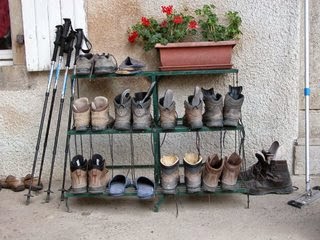
You have no idea what that meant to me. As a pilgrim walking 12-15 miles every day, my life had been somewhat reduced to the condition of my feet. I had blisters on top of blisters on my pinky toes, blisters on my heels, one or two nails were coming off, and all this was on top of calloused feet that were collapsing under my weight. The idea that at the end of the day someone else would free my feet from their boots, tenderly unbind them, and then wash them was almost more than I could bear. That this small community did this night after night for the throngs of pilgrims with their broken-down feet was almost unimaginable.
The tears also came from my realisation that in this little village church it didn’t matter if I was Catholic or not. It didn’t even matter if I was Christian or not. If I was a pilgrim walking the Way, I was welcome. Even if I wasn’t a pilgrim, I was welcome. The people who lived in the village wanted to minister in one of the most intimate ways possible and that offer was holy.
Unfortunately we were not to stay that night in the village but for the rest of the days as I walked, I thought of the day’s pilgrims arriving there and receiving the ministry of foot washing. In my spirit, I was washed and healed.
+
Tonight on this first night of the Triduum, the three holy or great days, we observe both the institution of the eucharist and the mandate to love one another as Christ loved us, embodied in foot washing. There are many similarities between the institution of the eucharist and the act of foot washing:
both build community and relationships
both involve self offering and sacrifice
both are deep expressions of love
both help us to remember and recall an event
both involve forgiveness
both involve healing of hunger, and weariness
both are incredibly intimate and soothing
Jean Vanier says in The Scandal of Service: Jesus Washes Our Feet, ‘These two symbolic acts [of Jesus, washing the disciples’ feet and giving himself up in bread and wine] around the body, his own body and the body of each one of his disciples are gestures of communion and love.… Without the eucharist we cannot live out such a deep presence and communion of the heart with others.’
He continues: Jesus came to make things new. For Jesus, each person is precious, each one is loved by God, each is called to become the ‘home of God’; each has a gift to bring to others, each one should be deeply respected.
+
This is what we are about tonight: celebrating the eucharist and washing one another’s feet. Most of all, we are remembering Jesus’ understanding that everyone is precious and everyone has a gift to offer the others.
When Jesus had washed the disciples’ feet, and taken his garments, and resumed his place, he said to them, ‘Do you know what I have done to you?’
As signs of love go, foot washing is one of the best!
For all of this we dare to ask you to have your feet washed, literally and figuratively. It is not easy to allow someone to wash your feet, that part of you where you feel least attractive (though I accept that my feet are those of a peasant). It was hard the very first time for the apostles. Peter said, ‘No way, Lord, you will not wash my feet.’
Washing and being washed cuts to the bone of what it means to love, and at the place that is raw, we encounter the real thing.
Jesus said to Peter, ‘If I do not wash you, you will have no part in me,’ which is to say, ‘If we do not learn the humility and the humiliation of love, we will not get it, when God tries to show us the divine, liberating love.’
Coming up to have your feet washed tonight, or remaining in your pew to think and pray about all of this, is in one sense all the same. Both can be profound; both can be a distraction.
What matters is the transformation, the opening up of our hearts so that when Jesus’ words come — ‘Do you know what I have done?’ — we will have an inkling, some sense of the immense, unspeakable transforming power of love, of that love that will not let us go, that love which will draw us to place we would never have thought of going.
So come, my friends: come to share, either quietly in your seat, or visibly up front in the chair, the memory of the time when Jesus loved his friends. Jesus still loves, still wants to help us let go of all the polite, protective, evasive ways of loving and being loved, and to open ourselves to the humbling, humiliating kinds of love which, when received and given, bring a dignity and worth we have never known.
‘Do you know what I have done to you?’
I invite you at this time, those who wish, to come forward and when it is your turn to be seated, take off your shoes and socks and, on behalf of all of us, learn of love.


The altar of repose is in the chapel. The church now is totally bare. And as I write this, there are people on watch in the chapel.






No comments:
Post a Comment