

The Feast of the Transfiguration, normally observed on August 6th, but moved forward a day this year, always seems to add a mid-course corrective into our collective faith journey. Here in the dog days of summer, when winter and Lent seem far away either in the past or future, the Feast of the Transfiguration, niggles at us. Why? Because the gospel reading we hear today is also the same one we hear the last Sunday of Epiphany, before plunging into Lent. While we are smack in the middle of the Season after Pentecost, I think having the memory jog is always good thing — namely, we go through the cross to get to eternal life. Sometimes we forget the final direction in which we are headed.
In the gospel according to Luke, the Transfiguration lands almost in the middle between the account of Jesus’ baptism and his prayer at Gethsemane. The gospel reading begins by saying that eight days have happened after ‘these sayings.’ The sayings to which Luke refers speak about discipleship and Jesus’ prediction of the passion, some of which we have heard in the past couple of weeks. It is eight days after Peter’s confession to who Jesus is, the Messiah of God. Peter, John and James accompany Jesus up the mountain, away from the plain where he has finished preaching. The end of Jesus’ Galilean ministry has come; Jesus now turns his face resolutely to Jerusalem, and the passion. At this turning point of the gospel, one at which Jesus has been identified for who he is and where the focus now shifts to the march to the cross, the action literally picks up.
While up on the mountaintop, ostensibly to pray, Jesus is joined by two well-known, historical figures, Moses and Elijah. They speak to Jesus about his exodus, which he is about to fulfill in Jerusalem. Jesus’ witnesses, Peter, John and James, sleep through the encounter, previewing how well they will remain awake the night before the crucifixion, perhaps also explaining Peter’s garbled response when he finally comes to.
As the disciples are figuring out what is going on around them, a cloud overshadows them — reminding us of the force that overshadowed Mary in the beginning of the gospel at the annunciation. Once again, Jesus is identified for who he is but this time, the identification comes from a heavenly voice, which declares: This is my Son, my chosen One. The voice adds a directive: Listen to him, a command that in other gospels and this one happens at the moment of Jesus’ baptism.
The gospel text is so rich we could spend hours on the many different threads that are woven into it. But one thread shines out this morning to me and it is because of where we stand as a faith community and where I stand as an individual. That thread is the thread of ‘exodus,’ or journey.
+
The gospel reports that Moses and Elijah spoke with Jesus about his exodus, which he was about to fulfill in Jerusalem.
There have been so many attempts over the centuries to identify the symbolism of the two Old Testament figures, Moses and Elijah. But the best suggestion I have run across states that Moses represents the prophetic office that Jesus will occupy, while Elijah pictures the hope of the world to come. Jesus will function as a Moses-like figure who will draw people around himself in much the way that Moses drew together the nation of Israel. With Jesus comes a new period, a new age, a new way of living and being God’s people, a new way of relating to God. And so Elijah is present on the mountain as a reminder of another time when people related to God in new, life-giving ways.
Equally important, though, is Moses’ connection with the Exodus. It is no coincidence that the three talk about Jesus’ exodus (the same word is used in the original Greek). Exodus — a word that takes on many levels of meaning: it is a departure that allows coming to life, to the resurrection. The exodus is the Passover, the passage to the promised land, a sign of the kingdom. Calling death an exodus means that death is not the end of Jesus’ plan. In fact, joined together in one sentence with the key word, ‘exodus,’ is another key word, ‘fulfillment.’ Jesus’ exodus — his journey to Jerusalem, his death on the cross and the resurrection — are part of God’s plan, which will come to pass. The transfiguration, then, foreshadows Jesus’ death on the cross. When Moses and Elijah talk with Jesus, they are talking about his departure, his death. Jesus has already spoken about the necessity of his death and shortly after this passage the gospel will refer to Jesus’ determination to go to Jerusalem.
But even as the transfiguration anticipates the death of Jesus, it also hints that death will not be the final word of this story. The dominant sense of this passage, after all, is one of glory, a glory that will most appropriately be given to the resurrected Christ.
Up on the mountaintop the disciples are face to face with the Holy. Face to face with mortality. Face to face with transformation of the world as they had known it. Face to face with their own new exodus. Face to face with the mysterium tremendum. Mysterium tremendum — literally the tremendous mystery — the awesomeness, awe-inspiring, fearfulness, incredible power of God. The face of God that we are hesitant to name — that face of God we do not nor will ever really be able to understand fully. That face of God that can and should sometimes make us afraid — not in a bad sense but in a sense of honest awe.
+
We stand at the top of a mountain this morning. Actually, we should feel as though we stand at the top of a mountain every time we gather to celebrate the eucharist. Every time we come together, we risk being transformed in deep ways. Every time we come togther, we go a bit further on our exodus as a prophetic community, grounded in history and tradition and faith. The eucharist is our reminder of all these things.
Even though we are not having one this morning as is fitting for this feast day, baptisms are also one of those transcendent moments when heaven and earth seem to come close and touch one another, when the veil between heaven and earth seems permeable (sort of how I think it must be on top of Mount Everest) and we can cross from here to there. Baptism is one of those moments when sometimes the only response of which we are capable is to cry holy tears because our souls are touched so deeply. Baptism is the moment at which each one of us was launched on our own exodus journey in the midst of the community, a journey that will ultimately lead us home, too. Most wonderfully, through baptism we have been marked and sealed as Christ’s own forever.
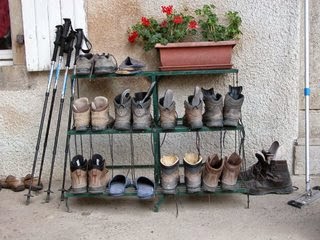
We know, however, that we cannot stay up on the mountaintop. Jesus did not let the disciples stay up there; nor should we want to stay there. We are about to come down the mountaintop to resume our exodus — the exodus that is our mortal life journey, marked by moments of the holy.
Along the way, our lives are transformed. Through the waters of baptism we come face to face with the mysterium tremendum. We come face to face to God through the three-fold splash of water and oil cross marked on our forehead at that moment of baptism. Through baptism, we became prophets — prophets of a new age and a new way of living. We are mouthpieces of the wondrous in-breaking of God’s realm in our time.
So let us come down off the mountaintop, knowing that God walks with us in the valleys, too. And let us risk having our lives touched and transformed once again as we continue our faith journey.






4 comments:
Caminante, this is truly inspired - or so it seems to me - an absolutely marvelous sermon. How blessed your congregation is to have a preacher like you.
Where did you find the beautiful picture?
Merci bien, c'est très gentil, cela.
"Where did you find the beautiful picture?"
I took it about 9.00 (between the 8.00 and 10.00) as we were setting up for the later service. In 2005 we had the stained glass window over the high altar restored and we have been enjoying reflections we had never seen (at least in the current generations).
Oh my! That's in your church! No wonder your preaching is so good.
Yes, it is a holy place, with over 150 years of prayers that have melded into its walls, floor and ceiling. It is a safe place and a loving place.
Post a Comment