Stand up against the surge
Molly Ivins - Creators Syndicate
01.11.07 -
The purpose of this old-fashioned newspaper crusade to stop the war is not to make George W. Bush look like the dumbest president ever. People have done dumber things. What were they thinking when they bought into the Bay of Pigs fiasco? How dumb was the Egypt-Suez war? How massively stupid was the entire war in Vietnam? Even at that, the challenge with this misbegotten adventure is that WE simply cannot let it continue.
It is not a matter of whether we will lose or we are losing. We have lost. Gen. John P. Abizaid, until recently the senior commander in the Middle East, insists that the answer to our problems there is not military. "You have to internationalize the problem. You have to attack it diplomatically, geo-strategically," he said.
His assessment is supported by Gen. George W. Casey Jr., the senior American commander in Iraq, and the Joint Chiefs of Staff, who only recommend releasing forces with a clear definition of the goals for the additional troops.
Bush's call for a "surge" or "escalation" also goes against the Iraq Study Group. Talk is that the White House has planned to do anything but what the group suggested after months of investigation and proposals based on much broader strategic implications.
About the only politician out there besides Bush actively calling for a surge is Sen. John McCain. In a recent opinion piece, he wrote: "The presence of additional coalition forces would allow the Iraqi government to do what it cannot accomplish today on its own -- impose its rule throughout the country. ... By surging troops and bringing security to Baghdad and other areas, we will give the Iraqis the best possible chance to succeed." But with all due respect to the senator from Arizona, that ship has long since sailed.
A surge is not acceptable to the people in this country -- we have voted overwhelmingly against this war in polls (about 80 percent of the public is against escalation, and a recent Military Times poll shows only 38 percent of active military want more troops sent) and at the polls. We know this is wrong. The people understand, the people have the right to make this decision, and the people have the obligation to make sure our will is implemented.
Congress must work for the people in the resolution of this fiasco. Ted Kennedy's proposal to control the money and tighten oversight is a welcome first step. And if Republicans want to continue to rubber-stamp this administration's idiotic "plans" and go against the will of the people, they should be thrown out as soon as possible, to join their recent colleagues.
Anyone who wants to talk knowledgably about our Iraq misadventure should pick up Rajiv Chandrasekaran's "Imperial Life in the Emerald City: Inside Iraq's Green Zone." It’s like reading a horror novel. You just want to put your face down and moan: How could we have let this happen? How could we have been so stupid?
As The Washington Post's review notes, Chandrasekaran's book "methodically documents the baffling ineptitude that dominated U.S. attempts to influence Iraq's fiendish politics, rebuild the electrical grid, privatize the economy, run the oil industry, recruit expert staff or instill a modicum of normalcy to the lives of Iraqis."
We are the people who run this country. We are the deciders. And every single day, every single one of us needs to step outside and take some action to help stop this war. Raise hell. Think of something to make the ridiculous look ridiculous. Make our troops know we're for them and trying to get them out of there. Hit the streets to protest Bush's proposed surge. If you can, go to the peace march in Washington on Jan. 27. We need people in the streets, banging pots and pans and demanding, "Stop it, now!"
31 January 2007

$2 a day

From Wikkipaedia

After United States currency was changed to its current size, the two dollar bill, unlike other denominations, was only assigned to one class of currency, the United States Note. United States Notes had a legal statutory limit of $346,861,016 that could be in circulation at any one time which was not a significant amount of money at the time. The bulk of this amount was assigned to the $5 United States Note. From 1929-1957 (from Series of 1928 to Series 1953), the $2 bill on average was printed in quantities of 50 million notes per series with only several variances to this number. From 1957 onwards, $2 bill production figures steadily decreased from 18 million notes in Series 1953A to just 3.2 millions notes in its final printing, Series 1963A, which ended in 1966. By contrast, an average of 125 million per series of $5 United States Notes were printed from 1929-1957; the final Series 1963 printing of the $5 United States Note included 67.2 million notes.
When the current note was first issued in 1976, it was met with general curiosity, and was seen as a collectible, not as a piece of regularly circulating currency, which the Treasury intended it to be. The main reason it failed to circulate was that businesses never really requested them as part of their normal operations to give back out in change. This failure is linked to the gradual disappearance of the former $2 United States Notes.
Supplies of the Series 1976 $2 bill were allowed to dwindle until August 1996 when another series finally began to be printed; this series, however, was only printed for one Federal Reserve Bank. Once again, in October 2003, the $2 bill was printed initially for only one Federal Reserve Bank after supplies dwindled. A Series 2003A was also issued starting in 2006, with larger numbers & for multiple Federal Reserve Banks, due to an increase in demand for supplies of the note.
Nowadays, there is a common misconception that the $2 bill is no longer in circulation. According to the Treasury, they "receive many letters asking why the $2 bill is no longer in circulation." In response, the Treasury states: "The $2 bill remains one of our circulating currency denominations. According to B.E.P. statistics, 590,720,000 Series 1976 $2 bills were printed and as of February 28, 1999, there was $1,166,091,458 worth of $2 bills in circulation worldwide." However, 'in circulation' does not necessarily mean that the notes are actively circulated, only that this is the amount that hasn't been redeemed for shredding. The Treasury states that the best way for the $2 bill to circulate is if businesses use them as they would any other denomination.
+
That's the history of the bill... but more important is the fact that today...
'Nearly one half of the world's population lives on less than $2 a day, and one sixth lives on less that #1 per day. More than a billion people lack access to safe drinking water. 25000 people a day die needlessly because food and basic health care are not available to them.'
We talked about this fact at youth group tonight and I gave each participant a fresh $2 bill with the above paragraph. I told them to put the $2 bill in place where they would see it often so that it could remind them of how most of the world lives and to think about it. Then we talked about ways that they each could make a difference with the Millennium Development Goals, such as buying nets to protect people as they sleep from mosquitoes infected with malaria, and the ONE Campaign.
Amazingly, the idea took off. There is something sweet about youthful enthusiasm. May it continue to be fired. One youth said he would get his bill laminated (so he wouldn't spend it!), and use it as a bookmark, and another was gungho to do a powerpoint presentation on malaria and nets and prevention to his 7th-grade class. Our Lenten project, it would seem, will be to raise money to give to Episcopal Relief and Development's gift of nets ($15 will buy nets and train people on how to prevent spread of the mosquitoes). Who knows? Maybe they will go for it and try to raise $325, enough for 25 families. Or maybe $700 for a village. We'll see.
Meanwhile, I pray for them, for their hope and belief that they can make a difference.
We have lost a great voice

We have lost a great voice today, that of Molly Ivins. Oh, how that woman could write. Oh, how she could pillary and skewer someone. And, oh, did she have a wicked sense of humour. Molly, wherever you are, give 'em a good ride. (As a Smithie, too, I am proud to say she is one of ours.)
Here's the obit that appears in the New York Times:
January 31, 2007
Molly Ivins, Populist Texas Columnist, Dies at 62
By KATHARINE Q. SEELYE
Molly Ivins, the liberal newspaper columnist who delighted in skewering politicians and interpreting, and mocking, her Texas culture, died today at her home in Austin. She was 62.
Her death, after a long fight with breast cancer, was confirmed by her personal assistant, Betsy Moon.
In her syndicated column, which appeared in about 350 newspapers, Ms. Ivins cultivated the voice of a folksy populist who derided those who acted too big for their britches. She was rowdy and profane, but she could filet her ideological opponents with droll precision.
After Patrick J. Buchanan, as a conservative candidate for president, declared at the 1992 Republican National Convention that America was engaged in a cultural war, she said his speech “probably sounded better in the original German.”
“There are two kinds of humor,” she told People magazine. One was the kind “that makes us chuckle about our foibles and our shared humanity,” she said. “The other kind holds people up to public contempt and ridicule. That’s what I do.”
Hers was a feisty voice that she developed in the early 1970s at The Texas Observer, the muckraking biweekly that would become her spiritual home for life.
Her subject was Texas. To her, the Great State, as she called it, was “reactionary, cantankerous and hilarious,” and its legislature was “reporter heaven.” When the legislature was set to convene, she warned her readers: “Every village is about to lose its idiot.”
Her Texas upbringing made her something of an expert on the Bush family. She viewed President George H.W. Bush benignly. (“Real Texans do not use the word ‘summer’ as a verb,” she wrote.)
But she derided President George W. Bush, whom she first knew in high school. She called him Shrub and Dubya. With the Texas journalist Lou Dubose, she wrote two best-selling books about Mr. Bush: “Shrub: The Short but Happy Political Life of George W. Bush” (2000) and “Bushwhacked” (2003).
In 2004 she campaigned against Mr. Bush’s re-election, and as the war in Iraq continued, she called for his impeachment. In her last column, earlier this month, she urged readers to “raise hell” against the war.
Mary Tyler Ivins was born on Aug. 30, 1944 in California and grew up in the affluent Houston suburb of River Oaks. Her father, James, a conservative Republican, was general counsel and later president of Tenneco Corporation, an oil and gas company.
As a student at private school, Ms. Ivins was tall and big-boned and often felt out of place. “I spent my girlhood as a Clydesdale among thoroughbreds,” she said.
She developed her liberal views partly from reading The Texas Observer at a friend’s house. Those views led to fierce arguments with her father about civil rights and the Vietnam War.
“I’ve always had trouble with male authority figures because my father was such a martinet,” she told The Texas Monthly.
After her father developed advanced cancer and shot himself to death in 1998, she wrote: “I believe that all the strength I have comes from learning how to stand up to him.”
Like her mother, Margot, and grandmother, Ms. Ivins went to Smith College in Massachusetts. Graduating in 1966, she also studied at the Institute of Political Science in Paris and earned her master’s degree at the Columbia University Graduate School of Journalism.
Her first newspaper jobs were at The Houston Chronicle and The Minneapolis Tribune, now The Star Tribune. In 1970, she jumped at the chance to move to Austin, where she became co-editor of The Observer.
Covering the statehouse, she found characters whose fatuousness helped focus her calling and define her persona, which her friends saw as populist and her detractors saw as manufactured cornpone. Even her friends marveled at how quickly she could drop her Texas voice for what they called her Smith voice. Sometimes she combined the two, as in: “The sine qua non, as we say in Amarillo.”
Ronnie Dugger, the former publisher of The Observer, said the political circus in Texas inspired her. “It was like somebody snapped the football to her and said, ‘All the rules are off, this is the football field named Texas, and it’s wide open,”’ he said.
In 1976, her writing, which she said was often fueled by “truly impressive amounts of beer,” landed her a job at The New York Times. She cut an unusual figure in The Times newsroom, wearing blue jeans, going barefoot and bringing in her dog, whose name was an expletive.
While she drew important writing assignments, like covering the Son of Sam killings and Elvis Presley’s death, she sensed she did not fit in and complained that Times editors drained the life from her prose. “Naturally, I was miserable, at five times my previous salary,” she later wrote. “The New York Times is a great newspaper: it is also No Fun.”
After a stint in Albany, she was transferred to Denver to cover the Rocky Mountain states, where she continued to challenge her editors’ capacity for prankish writing.
Covering an annual chicken slaughter in New Mexico in 1980, she used a sexually suggestive phrase, which her editors deleted from the final article. But her attempt to use it angered the executive editor, A.M. Rosenthal, who ordered her back to New York and assigned her to City Hall, where she covered routine matters with little flair.
She quit The Times in 1982 after The Dallas Times Herald offered to make her a columnist. She took the job even though she loathed Dallas, once describing it as the kind of town “that would have rooted for Goliath to beat David.”
But the paper, she said, promised to let her write whatever she wanted. When she declared of a congressman, “If his I.Q. slips any lower, we’ll have to water him twice a day,” many readers were appalled, and several advertisers boycotted the paper. In her defense, her editors rented billboards that read: “Molly Ivins Can’t Say That, Can She?” The slogan became the title of the first of her six books.
After The Times Herald folded in 1991, she wrote for The Fort Worth Star-Telegram, until 2001, when her column was syndicated by Creators Syndicate.
Ms. Ivins, who never married, is survived by a brother, Andy, of London, Tex., and a sister, Sara Ivins Maley, of Albuquerque, N.M. One of her closest friends was Ann Richards, the former Texas governor, who died last year. The two shared an irreverence for power and a love of the Texas wilds.
“Molly is a great raconteur, with a long memory,” Ms. Richards said, “and she’s the best person in the world to take on a camping trip because she’s full of good-ol-boy stories.”
Ms. Ivins worked at a breakneck pace, adding television appearances, book tours, lectures and fund-raising to a crammed writing schedule. She also wrote for Esquire, the Atlantic Monthly and The Nation.
An article about her in 1996 in The Star-Telegram suggested that her work overload may have caused an increase in factual errors in her columns. (She eventually hired a fact-checker.) And in 1995, the writer Florence King accused Ms. Ivins of lifting passages from Ms. King’ for an article that Ms. Ivins had written in Mother Jones in 1988. Ms. Ivins had credited Ms. King six times in the article but not in two lengthy sentences, and she apologized to Ms. King.
Ms. Ivins learned she had breast cancer in 1999 and was typically unvarnished in describing her treatments. “First they mutilate you; then they poison you; then they burn you,” she wrote. “I have been on blind dates better than that.”
But she continued to write her columns and continued to write and raise money for The Observer.
Indeed, rarely has a reporter so embodied the ethos of her publication. On the paper’s 50th anniversary in 2004, she wrote: “This is where you can tell the truth without the bark on it, laugh at anyone who is ridiculous, and go after the bad guys with all the energy you have.”
+
In 1999 when she was diagnosed with breast cancer, she told women: "I don't need get-well cards, but I would like the beloved women readers to do something for me: Go. Get. The. Damn. Mammogram. Done."
So, if you haven't, do.
30 January 2007
The things they don't teach you in seminary

There's lots they don't teach you in seminary (at least when I went) but here is today's short list:
• going to small claims court. That's what it looks like I will be doing on Valentine's Day. The church has run a nursery school as an outreach program for 32 years. The finances of this school have gotten increasingly more complicated. As a result, for a variety of reasons, we have a bunch of outstanding accounts that totals a good chunk of money. So on the 14th, I'll get to go to small claims court to initiate one of these cases.
• bleeding furnace oil supply lines. I really need to know how to do that since the supply lines to both the parish house and church freeze up every year when we have a protracted spell of minus 5 weather, as we have for the past two weeks. We'll have more of the same next week. The oil coagulates and then I have to call the furnace repair people to have them come over and bleed the line so that the oil can run again. I am sure we will be doing more of the same drill next week but I will be reading GOEs so won't be around for the fun.
• repairing cracked water regulators and then regulating them. The rectory regulator has been replaced, thanks to the generosity of a parishioner who spent two hours here yesterday, but my shower this morning was pretty feeble compared to previously.
• thinking outside of the box (!). Large rubric that covers a lot, so I can't even begin to detail this one but it's a good thing to ponder as I enter my 14th year of priesthood.
29 January 2007
Make her a priest in your Church
Thirteen years later today, I still pray this poem (whose author I do not know):

The day you were called
to break bread for a living
was the day you were called
to be broken.
The days you spend
bending over bread
are spent
bent around a mystery of fraction.
If you are indeed broken,
you need to gather up
each other's fragments gently,
and remember how,
again through you,
God feeds so many
with so little.
[photo from August 2004, the day I was made Canóniga Misionera de la Iglesia Anglicana Episcopal de El Salvador]

The day you were called
to break bread for a living
was the day you were called
to be broken.
The days you spend
bending over bread
are spent
bent around a mystery of fraction.
If you are indeed broken,
you need to gather up
each other's fragments gently,
and remember how,
again through you,
God feeds so many
with so little.
[photo from August 2004, the day I was made Canóniga Misionera de la Iglesia Anglicana Episcopal de El Salvador]
28 January 2007
Epiphany 4C

In another one of those glorious coincidences of the lectionary, this morning’s readings all focus on the theme of vocation and God’s call to each one of us. I place the emphasis on God’s call to each one of us even as I reflect privately on where my own call has led me over my lifetime and will pray publicly in a short time what the vocation of priest asks me to do. I find it curious that most of the commentaries I normally use in reflecting on the texts from Jeremiah and Luke place the emphasis on the ordained person’s call and leave out the most important part of the equation, the call of the baptised. This morning, I’d like to bring the rest of you, God’s people, on board.
Both Jeremiah and Jesus have a pretty hard time of it at the beginnings of their ministry. Both experience unique calls from God. Since we have heard about Jesus’ call at the moment of his baptism, let’s look at that of Jeremiah, which is less well known. Paradoxically, it is the reading appointed for the ordination of persons to the diaconate.
Jeremiah’s ministry spanned the last decades of Judah as a sovereign nation. Jeremiah witnessed firsthand all the paranoia, scheming, plotting and denial of the truth that erupts when power is being dismembered. During his time as prophet, Jeremiah saw the rise and fall of four Judaean kings — the beloved, Camelot-like king, Josiah; Jehoiachin who was kidnapped by the Babylonians after three months of rule, Jehoiakim, his arch opponent and Zedekiah, the puppet king.
God called Jeremiah to be a prophet about 627 BCE, during a calm period in Judah’s history. Even though beloved Josiah was working to protect the country’s borders, rumours about the great menace from the north flew about, provoking great paranoia. Assyria was about to fall apart and be conquered by Babylon and all the kingdoms south of there were trying to figure out what would happen to them.
Being called to be a prophet during a period of such uncertainty surely was the worst thing that could happen to someone. Worse, to be appointed as the one who would pluck up and pull down, destroy and overthrow, build and plant, was a surefire way to meet up with the rulers’ anger. And yet that is what happened to Jeremiah and it was no mistake.
Like Moses, Jeremiah was not at all eager to become a prophet. From what we have just heard, he protests, claiming he is a boy and does not have the right words (as Moses also did claim). But God would not have it; nor could God’s call be avoided. God commanded Jeremiah not to speak of himself as a boy and not to be afraid of the powers he would confront. God would be with him, for God’s calling was not something spontaneous, but something set forth from the time Jeremiah was in his mother’s womb.
God makes no promises that life as God’s mouthpiece will be easy. God understands that speaking the truth in God’s name will bring down contempt and hatred on the prophet. Yet God promises Jeremiah that no matter what, ‘I am with you, to deliver you.’ With those words of promise, Jeremiah exhorts his people as God has called him to do.
+
Whereas the first reading speaks of the moment of call, the gospel reading goes a little further in the story, telling what will happen once God’s chosen one will speak God’s words. Jesus has just proclaimed Isaiah’s prophetic words of societal reversal — words that greatly upset his listeners. Moreover, Jesus has refused to heal them, telling them he cannot do such things in his hometown. Whatever initial respect his listeners had for him has now melted and transformed itself into hatred — hatred so strong that they try to kill Jesus. Their challenge to Jesus’ powers is not the last: it will be echoed in the crowd’s taunt for him to come down from the cross and save himself. Rejection may be Jesus’ lot, but it never overcomes him — instead, God’s redeeming love overshadows everything.
+
Maybe some of you are thinking that it’s fine by you if this prophetic call and rejection stuff land only in the lap of the ordained. Maybe it feels safer to cast all this strife and difficulty on those whom God has called to ordained ministry. But I don’t quite think that is what the ministry of the baptised is about. If we claim to share in Christ’s priesthood through baptism, then each one of us is called in a very particular way to do two things: in my friend Porter Taylor’s words, to talk to God and remind others that this is possible, and to pollinate that world with God’s spirit. I add in a two more things: to be witnesses to God’s outrageous justice and love and to be bearers of hope. Just as God never promised Jeremiah it would always be easy to do these things, neither do our baptismal vows. But we, like Jeremiah, have God’s words of promise: ‘I am with you, to deliver you.’
First, each one of us can remind those whom we meet in the course of the day that God is present and walking with us and to speak of God’s presence. Maybe it is to my colleague who is down because of family illness. Or to a friend who suffers from seasonal affect disorder, particularly acute at this time of year. Or to those with whom I disagree politically (even within the larger church!) but still love. All are occasions when we encounter God; all are occasions when we can remind ourselves and others of God’s presence in our midst. All are occasions when we can talk to God with the words of our lips or of our heart.
Each one of us can pollinate the world with God’s Spirit. Just as the sun sparkles on the frozen crystals formed by an early river’s mist or the granite-like snowflakes we saw last night, the Holy Spirit settles on each one of us at the break of day. Throughout the day, however we do it — in a word, a smile, a silent prayer, a thanks to God for the sheer miracle of living, we can cover our environment and those around us with God’s Spirit.
Pollinating the world with God’s Spirit also means we sometimes have to speak the hard truths, to say those things with which not everyone may agree. Being baptised is not a popularity contest; exemplifying God’s inclusive love sometimes means taking on the status quo. Those whites and blacks who walked hand-in-hand during the 1960s civil rights marches knew what that is about. Those who became buddies to people with AIDS in the 1980s knew what that is about. And even the school child today who stands up to those who are bullying another child know what that is about. The examples are many. Our call demands that clarity of us.
Lastly, each one of us has been called from the moment we were in our mother’s womb to bear witness to the God of hope. That hope lies in our faith in the resurrection. We are always dying; we are always rising. Each one of us is something that was cast down and being raised up, something that had become old that is being made new in Christ’s name. In that rebirth lies our hope, a hope we must share with others.
Having been on both sides of the desk, as it were, I think that living into one’s Christian vocation is a lot harder as a member of the baptised than as a member of the clergy. Clergy have built-in support — a title, a uniform with a universal signifier (the collar), and society’s permission to talk God-talk. The latter gift is perhaps the most critical. People expect me to talk about God, and bring God into conversation — they tell me to pray because ‘that’s what you’re supposed to do.’(They also want me to cover my ears if they say something bad but I tell them my ears have heard those words before.) It is less risky, I think, for me to do that than you. So the challenge for all the baptised lies in how to find one’s voice and be comfortable speaking about God even when doing so might be unexpected. Together we can take that challenge on.
Don’t be afraid to live into baptism. At the moment water was sprinkled on our head, and oil marked on our forehead, we heard God’s wonderful words: ‘Don’t be afraid — for I am always with you and will deliver you.’ Surely with that promise, we can do what God has called each one of us to do. We can be the prophets we already are.
[photo of the 10.00 HE congregation on Trinity Sunday 2006]
27 January 2007
Guide us waking....

These little angels have flown over my head for about 15 years. There was a great little store, La Palma, that was over on 20th or 19th, I no longer remember, between 8th and 7th Avenues in New York City. I would wander over there on occasion and inevitably come home with something, either little La Palma painted things, such as these angels, or Guatemalan telas. At the time, I dropped money I shouldn't have but all these years later, I have not regretted it.
Ever since I bought these angels, I have hung them on the wall behind the head of my bed. I like to think of them creating as well as preventing mischief. Not in the picture is a Mexican rosary made out of stones, a small medallion of San Romero de las Américas, a Guatemalan cross, the first one I ever got, and two other little La Palma designs.
Despite these protecting angels, they have not prevented me from wasting the day on furnaces and plumbing. The rectory limps along with super low water pressure; we backed off the main supply so it won't leak as much, but as far as fixing the leak, it's beyond the capacities of the kind parishioner who came over last night and again this morning. To fix the leak properly, we will have to replace the regulator, way too complicated. I am pretending I am in El Salvador where water pressure can be quite low or running water not all except for 45 minutes every 24 hours.
Meanwhile, the parish house furnace has quit, most likely for the same reason that the church furnace quit this week: frozen supply line. We just don't have enough snow cover to protect the line and with this super cold weather (down to minus 23 last night), the oil doesn't have a chance. I am waiting for the furnace repair people to call back. It has already been 45 minutes and I have just been told it will be another 20. Sitting around for these type repairs wastes a lot of time and gets frustrating, even though I have a lot of sympathy for the furnace repair folks and am most glad I am not the one who spends all day working in cold spaces getting frozen fingers.
The church was 28 yesterday morning so that cold space killed off the poinsietta. No small loss to the head of the altar guild who more than happily removed their carcasses from the church this afternoon.
Voici le petit train-train d'une prêtre rurale.
26 January 2007
I heard water running

I wish I had sooner than I actually did. In fact, I never did. It's the town who called to say that the water usage had gone from 500 gallons to 1400 gallons. Oy veh. More than the extra cost we'll have to pay is the total waste of water.
Naturally, the leak is just a foot above the water meter; if it were below, the town would be liable. It never works that way.
This is an old house with an old foundation (stacked slate). Unfortunately, the big hole in the foundation, which is badly stuffed with insulation (an incomplete job) such that I can see daylight through the cellar wall, is right by the water pipe. So what you see in this picture is a fountain of water that has frozen. The cellar is probably about 25 degrees.
So, as I wait for someone to come over with insulation and perhaps fix the leak, I have turned the water supply almost all the way off and left the kitchen sink running.
This comes at the end of a day when I went into the church this morning to find it was 28 in there because the oil had coagulated and the furnace quit.
The high of the day was minus 8.
The deacon with whom I am working wanted to experience life in a small rural parish. I keep telling her that a lot of my day is spent with old buildings and furnaces. Every once in a while, I get to do something sacramental.
Friday cat blogging

Here's the Waif, three weeks after capture. The first two weeks were rough because she was semi-feral and very fighty-bitey. My hands showed her skill in fending off human touch. She has calmed down but still 'sundowns' on occasion, getting nutty after dark. Still, she is coming around slowly and there's hope. She'll sojourn here, even though I still don't know for how long. I am just glad she is not out in minus 15 degree weather (as it is right now).

The World's Best Cat Sitter gave the Unholy Three a feeder to replace an ancient thing I had which came with my former pair. As a rule, I don't keep it out (even Orange Boy was yesterday deemed a little overweight at 11 pounds) because they snarf the crunchies down so fast, but as a treat I put it out last week. Young Guy doesn't know how to butt in and just sits there meowing and getting frustrated. La Doyenne and Orange Boy take turns eating out of the feeder though, here, Orange Boy is using the tried and true paw technique.
25 January 2007
Heigh ho, off to the vet's

Last week I reached a breaking point in realising that I had not had any days off, any time off, any time away from church matters. I was inundated by emails from church-related entities and it was driving me crazy. So I decided that Monday, Thursday truly are my days off (I am paid 2/3 minimum compensation which means that I get a paid day off a week and two unpaid days) and that means no church-related emails and an attempt to keep church-related work to a minimum. I had let that slide too much in the past couple of years and all of sudden last week, it really caught up with me.
It's hard, however, to maintain that barrier without guilt or panic and I did spend some time working on Executive Council things because I am up against a deadline. And this evening I worked with a parishioner on our emerging church web site (hooray).
But the major portion of the afternoon was hauling two cats off to the vet's. I have the Unholy Trinity who are the full in-house residents and since 21 December I have a semi-feral stray, the Waif, in the back half of the upstairs of the rectory, a sort of unfinished part of the house over the kitchen. Today was the big day of taking Orange Boy and the Waif to the vet's.
The World's Best Cat Sitter wanted to come along so she kept Orange Boy (aka Mr Cool) company in the backseat while I had the Wild Waif in the front seat. Needless to say, both felines were in cages... partly because they have never met!
They still aren't going to meet because I need to go through the two-week process of deworming the Waif (pilling her went OK tonight; tomorrow I get to squirt 2ccs of nasty banana [????? why do they do that for animals? it's stupid]-flavoured goop into her mouth). At that, the Waif may continue to enjoy a private suite in the back half of the upstairs while the Unholy Trinity maintains its turf in the rest of the house.
Keeping two potential warring factions apart is a good diversion, ¿no?
The people at ORAH are good. When another Orange Boy of mine died in 1999, the vet was so gentle with me, bringing him to me, wrapped up in a blanket and letting me stay in an examining room with him for as long as I needed. They know not only how to handle the animals with love and care but also the people.
(I am sorry they no longer have week-end emergency care — I am not sure about basic boarding; if there's an emergency, one has to drive 50 miles upstream to a fancy, fancy animal hospital. I guess it just wasn't cost effective to stay open during week-ends. )
I have long thought that if I ever get to retire, I would become a non-denominational chaplain in a vet's waiting room. There's all sorts of life stuff that happens for which a chaplain would be appropriate... like the time I was waiting to get the former Orange Boy's ashes, and I made small chat with a 20-something woman. I asked if she was waiting to get a pet and she said she was paying for her kitten who had died. I made appropriate noises and asked how it had died and she said that her boyfriend had beaten it to death. I simply said that if he could do that to a kitten then he could do it to her if he wasn't already doing it and she needed to be really, really careful. Or the time that I saw an old Vermont farmer, all 'broke down,' sitting in the waiting area with an empty leash in his hand. You didn't have to ask. You knew he'd just brought in his dog to have it euthanised. So, yeah, if I ever get to retire, and a vet would like one, I'll be a chaplain to the creatures and humans alike.
24 January 2007
Hiding out, sort of, and reading!

I know it's not Friday yet but this is sort of how I feel right now, wanting to go hide under a blanket (fortunately, it's late enough in the day that I can), like Orange Boy.
I don't know why I am so tired all the time but I am. Whatever, the idea of closing up shop early sounds really good to me.
Besides, it's below 0 out and no sane person or cat should be up and about when it's like that, especially in an old drafty house like this one.
Even better, I have two new books, in the sense of 'hot off the press,' with which to spend time:
The first is Presiding Bishop Katharine Jefferts Schori's A Wing and a Prayer (Harrisburg, PA: Morehouse Publishing, 2007), a collection of meditations and the two homilies she preached the weekend of her investiture and seating at the Cathedral in Washington. I have already peeked at several meditations and look forward to reading the entire collection. In her meditation, 'Sharing the Wealth,' she speaks of an event that happened in the fall of September 2005 that still brings tears to my eyes because right after this happened, El Salvador then was hit with a rain storm that wouldn't go away and caused great flooding and loss of homes:
'The Diocese of El Salvador is poor and rural, with five thousand Anglicans and six clergy gathered in seventeen congregations, and they know something about hurricanes.... In late September of 2005, after hurricanes hit the Gulf Coast, the bishop of El Salvador [the Most Rev'd Martín Barahona] promised that his diocese was going to contribute all of their income from that month to relief work on the Gulf Coast. All of it, from every congregation in the diocese. Every penny. They know what it is to be victims of natural disaster, and they are sharing what they have with others who have lost everything. Their knowledge of common suffering prompted a desire to share, and it brings joy to all' (55).
That is but a small taste of PB KJS's new book.
The second book is the Rev'd John C. Morris's First Comes Love? The Ever-Changing Face of Marriage (Cleveland, OH: Pilgrim Press, 2007).
John is a colleague of mine and this book represents the formalised presentation of his oft-presented talk, 'The Twenty-One Traditions of Marriage.' John is a fabulous story-teller, a former elementary school teacher (which means he can access concrete examples in ways that many of us can't) and inquisitive student of something, marriage, that we all think we know a lot about. As his book shows us, we don't. As for the notion of 'biblical marriage,' well, just read the first four chapters.
I feel I know his book because I have attended two or three of his presentations and even translated one (with his permission) into Spanish to use in El Salvador last summer. So I look forward to seeing how he has synthesised his talks into a book that even at first glance and rifling through its pages, retains John's wonderful sense of humour and maintains a readily accessible and useful resorce for individuals and study groups.
Is this a plug for my friend's book? You betcha it is!
Worth closing up shop and going to bed to read for!
23 January 2007
I'm turning into a Honore de Balzac

Honoré de Balzac, known for his Comédie Humaine (of which I read a lot during my years as a French major), was infamous for his crazy, crazy work habits. He would sleep all day, then work furiously all night, sometimes up to fifteen hours, fueled by gallons (or shall I say liters) of black coffee, then hit the town and go out socialising, come back in the late hours of the morning (4.00 or 5.00), go to bed and start all over again in the afternoon.
My cicadian clock is way out of kilter these days so I find myself, if left unfettered by appointments, going to bed at 1.30 and waking up at 9.00 or 9.30. It's embarassing for someone my age to be keeping such adolescent hours, hours normally associated with the 20 year-old crowd but that is where my little pituitary gland seems to be stuck.
Meanwhile, Balzac wrote some amazing pieces of literature so you can't disparage him for keeping odd hours. At least he was productive, if not ecentric.
22 January 2007
A spin-off from Mad Priest
One of Mad Priest's (http://revjph.blogspot.com) postings this evening speaks about the fast-track to sanctification of John Paul II, how in less than two years since his death, the Process is moving forward ever steadily.
In the comments, I wrote:
'Meanwhile, San Romero de las Américas [Oscar Romero] lags in the process 27 years after his martyrdom. His miracle? That he said what he said and that the people of El Salvador still love him and cite him and he lives on in their spirit. But is that good enough? No, we have to go through the REAL miracle basura. Worse, for the 25th anniversary of Romero's assassination, the powers-that-be moved his body for the third time, and took down the tomb that was accessible to everyone and made a triumphalistic one that is separated from the hoy poloi by ropes. Cheez.'
Romero said, 'If I die, I will rise again in the people.' Yes. That is his miracle. We don't need to hear about miraculous healings. That's not who or what Romero was about.

The photo here is of the old tomb, the one that we knew up until March 2005. Readily accessible, a place where young and old would come to pray, lay their hands on the stones, weep, leave flowers, leave posters (I took this photo in March 2004, during the week of commemoration of the 24th anniversary of his martyrdom), and just be.
But this tomb was deemed insufficient and not elegant enough for Romero. So here's what they came up with.

When I first saw the photos of the tomb in March 2005, right after the powers-that-be had translated Romero's body (for the third time!) from the side crypt, which they deemed too dark and too small, to the crypt under the high altar, I noticed right off the ropes. I though that perhaps they were there for the commemorative week. But, no, when I went to the tomb in October 2005 and subsequent visits (including the most recent August 2006), the ropes were still there.
How unlike what San Romero would want. What I have discovered (where there is a will, there is a way) is that one can still touch the tomb, despite the ropes. If one stands directly behind the head of the tomb, one can reach over and touch the statue's mitre. No secret here, the top of the mitre is already getting burnished by other's hands.

It's not the same as being able to place one's face on the tomb or hands on the tomb. No, that intimacy is lost. But, for the time being, one is not entirely cut off from touching the tomb of a holy man.
Fact is, we don't need to have Rome's approval of Romero as a saint. He already is for so many.
Even the Episcopal Church's General Convention last year approved inclusion of Romero on its Lesser Fasts and Feasts calendar, 24 March (1980).
So whether he ever formally becomes one in Rome's eyes, he already is for the people of El Salvador, las Américas and the world.
In the comments, I wrote:
'Meanwhile, San Romero de las Américas [Oscar Romero] lags in the process 27 years after his martyrdom. His miracle? That he said what he said and that the people of El Salvador still love him and cite him and he lives on in their spirit. But is that good enough? No, we have to go through the REAL miracle basura. Worse, for the 25th anniversary of Romero's assassination, the powers-that-be moved his body for the third time, and took down the tomb that was accessible to everyone and made a triumphalistic one that is separated from the hoy poloi by ropes. Cheez.'
Romero said, 'If I die, I will rise again in the people.' Yes. That is his miracle. We don't need to hear about miraculous healings. That's not who or what Romero was about.

The photo here is of the old tomb, the one that we knew up until March 2005. Readily accessible, a place where young and old would come to pray, lay their hands on the stones, weep, leave flowers, leave posters (I took this photo in March 2004, during the week of commemoration of the 24th anniversary of his martyrdom), and just be.
But this tomb was deemed insufficient and not elegant enough for Romero. So here's what they came up with.

When I first saw the photos of the tomb in March 2005, right after the powers-that-be had translated Romero's body (for the third time!) from the side crypt, which they deemed too dark and too small, to the crypt under the high altar, I noticed right off the ropes. I though that perhaps they were there for the commemorative week. But, no, when I went to the tomb in October 2005 and subsequent visits (including the most recent August 2006), the ropes were still there.
How unlike what San Romero would want. What I have discovered (where there is a will, there is a way) is that one can still touch the tomb, despite the ropes. If one stands directly behind the head of the tomb, one can reach over and touch the statue's mitre. No secret here, the top of the mitre is already getting burnished by other's hands.

It's not the same as being able to place one's face on the tomb or hands on the tomb. No, that intimacy is lost. But, for the time being, one is not entirely cut off from touching the tomb of a holy man.
Fact is, we don't need to have Rome's approval of Romero as a saint. He already is for so many.
Even the Episcopal Church's General Convention last year approved inclusion of Romero on its Lesser Fasts and Feasts calendar, 24 March (1980).
So whether he ever formally becomes one in Rome's eyes, he already is for the people of El Salvador, las Américas and the world.
21 January 2007
Epiphany 3C • 21 January 2007

The gospel reading this morning is the same one that was proclaimed in the National Cathedral on 4 November 2006 at the investiture of the Most Rev’d Katharine Jefferts Schori. Presiding Bishop Jefferts Schori preached on this text, clearly one that exemplifies her understanding of living out and proclaiming God’s reconciling and justice-seeking message to the world.
Jesus opens the scroll and reads a composite from Isaiah 61 and Isaiah 58. This portion is rich in overtones recalling verses of the Hebrew Scriptures and other parts of Luke’s gospel itself. The passage is carefully chosen because Isaiah 61 is what is known as one of the Servant Songs, those songs that have been later seen in light of Jesus. The figure in Isaiah 61 brings a message of redemption and of God’s deliverance to the exiles. Jesus goes a step further by declaring that he is the one who will bring about the dawning of the new age of salvation. Jesus ties in Isaiah 58 by meeting in love the needs of those who need God, something Israel had not done. At the same time, his words recall those powerful words of the Magnificat and the Nunc Dimittus.
Jesus reveals his mission of salvation as the Anointed One, the one with the message of good news. Preaching the good news is fundamental to Jesus’ ministry and to the gospel of Luke. He is light and liberator to the poor, captive and blind. He calls the community to a revolutionary way of showing God’s love for all and to offer comfort to those of God’s people who have suffered oppression. By asking the community of God to free the captive and give light to the blind, Jesus also asks the community of God to consider how it stands in relationship with people and societal structures. First most, the community is called to proclaim good news to the poor, release to the captives, sight to the blind, freedom to the oppressed, and a year of Jubilee, a year when all debts are erased and all are equal in God’s sight.
Amy Spagna, in a blog devoted to commentary on this particular passage, The Year of the Lord’s Favor [blogspot.com], writes:
For so many, this passage from Luke sums up both who this Jesus is, and “the mission of the Church.” Jesus is preaching — well, attempting to, anyway — in his hometown. He’s trying to tell the people who remember him jumping into mud puddles as a boy, and working in his father’s wood shop as a young man, what he’s really here to accomplish. He’s got a very specific job, which is to bring the good news of God’s love to those who haven’t yet heard or believed it, and to tell those who aren’t aware of it that God does indeed look upon them favorably.
Of course, they don’t believe it. What, Joseph’s kid, saying these things? Impossible. Impossible that God could give his blessing to the beggar on the corner, much less to anyone who isn’t Jewish. And yet, there he is, doing it anyway.
Throughout the Gospel accounts Jesus makes a point of hanging out with the slimy underbelly of1st-century society. The writers also take pains to point out that the slimy underbelly often has more faith than for which it is given credit. Take, for example, the story of blind Bartimaeus. Nobody who tossed a coin into his cup probably thought that a blind man, who was obviously paying the price for some sin or another, would have his sight restored simply because he believed enough to ask for mercy. Ironic, that a blind man saw and understood what so many others could not, until after the crucifixion: this Jesus was special, because the spirit of the Lord was upon him.
Not much has changed in the world in the past 2000 years. The slimy underbelly of society is still there, it still needs help from those in more privileged positions. So what are we gonna do about it? One of the less well-publicized outcomes of last summer’s General Convention was the focus both Houses directed towards the UN Milennium Development Goals. The MDGs are, if properly implemented, good news to the poor who so desperately need the physical resources they will provide. The MDG initiatives are also good news to those who are poor spiritually, who need the message we Episcopalian Christians bring: see, this thing is being fulfilled in front of you, today, in the here and now.
And what a chief messenger we have in Bishop Katharine Jefferts Schori. She keeps saying that what we’re about in terms of mission is helping those who need it the most. Which is what “Gospel” is, really. As a friend kept trying to get across before he died, each of us is a gift that is meant to be shared, because there is always someone out there who desperately needs what each has to offer. Episcopalians have a heck of a lot of good stuff — that is, if we can stop bickering with one another long enough to see the blind Bartimaeuses of the world and offer that stuff to them.
We are the Lord’s appointed in this tremendous task. So let us join with Bishop Katharine, and proclaim by both word and deed that this is indeed the year of the Lord’s favor. [end quote]
As Amy Spagna wrote, ‘We are the Lord’s appointed in this tremendous task.’ Here, at Saint Mary’s, as small as we might feel sometimes, each one of us can make a difference. You and I are called to bring the message of God’s Jubilee (not vengeance) to Northfield and its environs, to our places of work and recreation, even to our families. It’s hard work sometimes but doing so is part of our commitment, as expressed in our baptismal vows.
Think about this charge of being a people of Jubilee as we move into our annual meeting. Think about how you in partnership with Saint Mary’s can be a reconciler, peace-maker, and instrument of God’s justice and favour here, now, always.
And may God who has given us the will to do these things, give us the grace and power through our baptism to perform them.
***
Though the photograph is from October 2005, the light is about what we saw this morning at 9.00 at our combined service. The deacon was sitting over on the left side and the reflection of the stained glass was highlighted by his white, white alb. It was one of those moments when I wished I had a bitty camera to take a photo because he was entirely bathed by stained glass window reflection. The most identifiable was a small green cross with purple edge. Really quite striking.
***
I am truly catatonic and verbally kaput after annual meeting and then going to a wake of someone who was simply a nice, nice honest contractor, whom everyone in town knew, and who died of a brain tumour that was diagnosed right after Christmas of 2006. He was only 62. His daughter and son-in-law decided not to wait until this spring to get married and, instead, were married two weeks ago alongside her dying father's bed in the respite home where he was at the time of his death. May Brian rise in glory and may his family be gently held by God.
Though this town is 3000 (plus 1800 university students), it still has a small-town feeling. I always feel that when I go to wakes, whether they are ones at which I will be leading prayers or ones where I go as a community member, as in this afternoon. There is only one funeral home in town and after 13 years being here, each time I end up at one of these things, I get the sense of small-town 'Americana.' You see everybody; you chat with each other, in my case, I chat with the guy who owns the funeral home (a decent person), and you know that you will return again and again.
Where I grew up, we didn't and don't do wakes. It's just not part of our culture. In my family of origin's circle of friends, they simply do a service and then a gathering afterwards, usually back at the home of the family. So the open coffin, viewing at the funeral home the night before the burial was something new to me when I went into the ministry.
If I knew how to do such things, the way Mad Priest does, I would insert here Blood, Sweat and Tears song, 'And when I die...'
'And when I die, and when I'm dead, dead and gone.... there'll be one child here to carry on, to carry on.'
20 January 2007
Here we go again....
If you support the war and the increase of troops in Iraq, read no further. If you don't, then proceed.
Here we go again, more rallies, more marches. I won't put in every one I attend, but given the weather of snow, I thought some photos would be interesting.
I love Vermont for its feistiness. And I do have a deep affection for our State House, because we can go in there, talk with our representatives and senators. We truly have access in ways that I imagine in larger states one doesn't.

Anyway, so very Vermont-ish, so very 21st-century, rather than 1960s Vietnam War protest rallies as someone old enough to have gone to such things chided me. I started the morning off with a croissant and coffee, knowing I was going to be spending 90 minutes or more standing outside in 10-degree weather. Good book, too, BTW (Imperial Life in the Emerald City). I carried a sign I made that refers to the interview this week with Jim Leherer and the President: 'The egg is broken, not cracked, Mr Bush' (i.e., is a cracked egg any better than a broken one????).

Some Vermonters had posters of Iraqi citizens, while others carried boots representing Vermont's 21 fallen troops. I asked the man who had these boots, if the deceased was a relative of his and he said no. The woman next to him rebutted both of us, saying, 'They are ALL ours.' She had tears in her eyes. I stood chagrined.
We had all of Main Street and State Street to ourselves so the organisers kept telling us: Spread out! You don't need to bunch up! You have the whole street to yourself! I think the signs say a fair amount. No Bread and Puppet Theater people there but there were a few big puppets. (I remember in the march on Washington in 1991 during the FIRST Iraq War, walking down Pennsylvania Avenue in front of Bread and Puppet -- they had three groups: skeletons, weeping women and birds. I wish I could remember if the birds were doves or vultures because it makes quite a difference in the statement.)

It is a relatively short walk from City Hall, where we started to the state house, one I do often because that walk largely covers the entire commercial area of Montpelier (we have the country's smallest capitol, after all). We walked past the Episcopal Church in town and, actually, I ended up walking with a colleague who has long been an activist, who would dearly love to be in Washington DC next weekend save for annual meeting. Neither she nor I can bear the idea of arriving back in Vermont at 5.00 AM (having travelled all night by bus) to tackle Sunday morning. So we showed up today and will let others walk for us next week.

The state house sits on a small rise and is built of Barre granite (of course — Rock of Ages quarry, that up until this year, had the contract to make the tombstones for all the national cemeteries, including Arlington... now they are in competition with China and other places). Flags are still at half mast for Gerald Ford, an interesting historical juxtaposition. The steps were mostly cleared of snow.
The rally lasted an hour because of the snow and low temperature.

A brave soul, who had won a contest for the best anti-war song, bravely bared his fingers and played his guitar in accompaniment to his words. I don't remember them — something about being mad and stopping the escalation.

The shot looking backward to show the crowd (we were about 300, which is pretty good, given the driving conditions, but there were a bunch of people from Burlington and even further, Enosburg Falls). The building in the background across the street is where the Department of Motor Vehicles resides.

The side shot simply shows the length of the crowd. It's always good to spread out across the lawns. In the background is the building for the Vermont Historical Society (to the right), in a former hotel. The modern edifice behind it is the Pavillion, where all sorts of state offices (including income tax, I've been there, unfortunately!) live.
The boots on the capitol steps represent Vermont's fallen. This state has had a disproportionate amount of soldiers per capita die in Iraq.
One of the speakers was a Marine on his last day of enlistment. He said he was standing in front of the state house, speaking at a rally against the escalation in Iraq on his last day of active duty and he was trying to figure out what his next 'mission' would be. He is having to find a new vocabulary and new ways of responding to the war. Two other Iraq vets also spoke.

Eventually the rally ended in a flurry of snow, sudden swirling gusts of snow. While the organisers had kept it short, the rally was long enough that we had cold fingers, toes, and faces. But at least we have our toes, fingers, faces and, indeed, lives. Being cold is a small, small thing to endure when put into that perspective.
Here we go again, more rallies, more marches. I won't put in every one I attend, but given the weather of snow, I thought some photos would be interesting.
I love Vermont for its feistiness. And I do have a deep affection for our State House, because we can go in there, talk with our representatives and senators. We truly have access in ways that I imagine in larger states one doesn't.

Anyway, so very Vermont-ish, so very 21st-century, rather than 1960s Vietnam War protest rallies as someone old enough to have gone to such things chided me. I started the morning off with a croissant and coffee, knowing I was going to be spending 90 minutes or more standing outside in 10-degree weather. Good book, too, BTW (Imperial Life in the Emerald City). I carried a sign I made that refers to the interview this week with Jim Leherer and the President: 'The egg is broken, not cracked, Mr Bush' (i.e., is a cracked egg any better than a broken one????).

Some Vermonters had posters of Iraqi citizens, while others carried boots representing Vermont's 21 fallen troops. I asked the man who had these boots, if the deceased was a relative of his and he said no. The woman next to him rebutted both of us, saying, 'They are ALL ours.' She had tears in her eyes. I stood chagrined.
We had all of Main Street and State Street to ourselves so the organisers kept telling us: Spread out! You don't need to bunch up! You have the whole street to yourself! I think the signs say a fair amount. No Bread and Puppet Theater people there but there were a few big puppets. (I remember in the march on Washington in 1991 during the FIRST Iraq War, walking down Pennsylvania Avenue in front of Bread and Puppet -- they had three groups: skeletons, weeping women and birds. I wish I could remember if the birds were doves or vultures because it makes quite a difference in the statement.)

It is a relatively short walk from City Hall, where we started to the state house, one I do often because that walk largely covers the entire commercial area of Montpelier (we have the country's smallest capitol, after all). We walked past the Episcopal Church in town and, actually, I ended up walking with a colleague who has long been an activist, who would dearly love to be in Washington DC next weekend save for annual meeting. Neither she nor I can bear the idea of arriving back in Vermont at 5.00 AM (having travelled all night by bus) to tackle Sunday morning. So we showed up today and will let others walk for us next week.

The state house sits on a small rise and is built of Barre granite (of course — Rock of Ages quarry, that up until this year, had the contract to make the tombstones for all the national cemeteries, including Arlington... now they are in competition with China and other places). Flags are still at half mast for Gerald Ford, an interesting historical juxtaposition. The steps were mostly cleared of snow.
The rally lasted an hour because of the snow and low temperature.

A brave soul, who had won a contest for the best anti-war song, bravely bared his fingers and played his guitar in accompaniment to his words. I don't remember them — something about being mad and stopping the escalation.

The shot looking backward to show the crowd (we were about 300, which is pretty good, given the driving conditions, but there were a bunch of people from Burlington and even further, Enosburg Falls). The building in the background across the street is where the Department of Motor Vehicles resides.

The side shot simply shows the length of the crowd. It's always good to spread out across the lawns. In the background is the building for the Vermont Historical Society (to the right), in a former hotel. The modern edifice behind it is the Pavillion, where all sorts of state offices (including income tax, I've been there, unfortunately!) live.
The boots on the capitol steps represent Vermont's fallen. This state has had a disproportionate amount of soldiers per capita die in Iraq.
One of the speakers was a Marine on his last day of enlistment. He said he was standing in front of the state house, speaking at a rally against the escalation in Iraq on his last day of active duty and he was trying to figure out what his next 'mission' would be. He is having to find a new vocabulary and new ways of responding to the war. Two other Iraq vets also spoke.

Eventually the rally ended in a flurry of snow, sudden swirling gusts of snow. While the organisers had kept it short, the rally was long enough that we had cold fingers, toes, and faces. But at least we have our toes, fingers, faces and, indeed, lives. Being cold is a small, small thing to endure when put into that perspective.
At least locally, the world is right again

Although it wasn't predicted (none of the predictions have been right this winter), we got eight or nine inches of fluffy snow overnight. Hooray! Finally, finally, things look the way they ought to.
To make the morning even better, my driveway has already been plowed out so I don't have to shovel the whole thing in order to get out in an hour. The town has a little snowplow that does the sidewalks, however, that creates a ridge of snow that blocks the end of the driveway but I usually can drive right over it if I don't have time to do the shovelling.
Still, when it snows like this, you will see the whole town outside, shovelling, snowblowing, and coping with the snow. It's like bringing all the animals out of hibernation.
Off to Montpelier to go stand in front of the capitol building (in 10 degree weather and wind), holding a sign that reads, 'The egg IS broken, Mr Bush.' That is in reference to that awful interview earlier this week in which he said that if the egg, Iraq, were broken, he would get us out of there but it's only cracked. Please.
19 January 2007
Better late than never even if it's not enough

Finally!!!! Some good snow! I know for those in southern climes, Brazil, Panamá, El Salvador, California, Florida, Texas, and elsewhere, the thought of being excited about a snowstorm seems ridiculous. Certainly for my sister out in Colorado this winter's four massive snowstorms have been a major problem as she and family are trying to build a house and keep having to shovel out the basement so that maybe some day, the floor can be poured.
But for snow-starved Vermont, a snowfall light tonight, one of those champagne-type snows that blows off the surfaces, is more than welcome.
I have long felt that no matter how sad or depressed or grumpy I get, along comes a snowstorm and it makes me feel better. And given that I have been in pre-annual meeting grumpies (along with a painful staph boil smack in the middle of my forehead), this snowfall is so good for the soul.
Thank you, Jesus :)
Friday cat blogging and how!

La Doyenne is an expert paper shredder. You don't need to go to Office Max or Staples and pay $50 for a paper shredder; just leave whatever you want pawed at, rumpled, chewed and spat out on the table. Newspapers are particularly delectable though an occasional $2000 cheque is most satisfying, if for the reaction it gets from the human when she discovers there are two chomp marks in the corner, even though she thought she had buried it way, way out of the way.

So Orange Boy decides for the first time ever, I think, to sleep in the little basket from Nahuizalco, El Salvador that normally is Young Guy's place. The trio is sleeping in totally different places; neither igloo as I call them has been occupied once this winter and I don't know why because the blanket and towel in each one respectively is clean. Who knows. Maybe it hasn't gotten cold enough, though this past week's minus 10 and 15 degree overnights was enough to shut the parish house down because the oil coagulated and couldn't get from the tank to the furnace.

Young Guy reestablishes ownership of the aforementioned basket. In it is a little sachet of French herbs, which he loves (someday I will find the other one that he lost playing with it), and he smells wonderful later so I call him Mr Herbie.

Long a favourite shot, the threads of that poor towel are so pulled from twenty years of cats sleeping on it, but it always makes a good photo and it protects the Thai pillows that reside under it. I can't remember seeing Young Guy on top of those pillows; it is always La Doyenne, sometimes Orange Boy and sometimes both of them as in this photo. A cat's raison d'être is to find new places to sleep and they do a good job of it.

Young Guy conquers yet another bookcase, this one in the guest bedroom (which is miniscule to begin with and the bookcase makes it even smaller). He sits between a hat from Guatemala and from San Vincente, El Salvador. As I recall, the hat maker where I bought the hat in 1996, one of the best, was badly damaged in the 13 February 2001 earthquake . As in Panamá, each region of El Salvador has a distinctive design for its hats.
18 January 2007
No hay más palabras al fin del día

Señor, haznos instrumentos de tu paz.
Donde haya odio, sembremos amor;
donde haya ofensa, perdón;
donde haya discordia, unión;
donde haya duda, fe;
donde haya desesperación, esperanza;
donde haya tinieblas, luz;
donde haya tristeza, gozo.
Concede que no busquemos ser consolados, sino consolar;
ser comprendidos, sino comprender;
ser amados, sino amar.
Porque dando, es como recibimos;
perdonando, es como somos perdonados;
y muriendo, es como nacemos a la vida eterna. Amén.
17 January 2007
Juxtapositions

I live in an 1856 house, the church rectory. It's a great house and, surprisingly, one that isn't trashed up badly from multiple inhabitants. The church didn't buy it until the late 1960s so the house already had a century of different residents. Before then, it had been a two-family home, first upstairs and downstairs, and then the upstairs back half was a small studio apartment. Back in the 1950s, it even was the home of a Pentecostal meeting where, according to a parishioner's book about her childhood in town, people talked about 'GEE-sus.' A former rector was great friends with a guy in town who bought an Italian restaurant and changed it into a respite home and the two men lugged the bar from the restaurant over to the rectory and installed it in the cellar where it resides to this day, moldering in cobwebs. (Some day I will take an axe to it and destroy it.)
As far as the house is concerned, I am sure it never thought in all its Vermont years, to have Panamanian molas, Guatemalan morales and Salvadoran coffee bags up on the walls and in its rooms. But with this inhabitant, this house has learned to live with a diverse (i.e., eclectic) collection of furniture and adornments ranging from my grandparents' Victorian furniture to the above items.
The coffee bag, a real one, comes from a coffee plantation outside of San Salvador in Sta Tecla. A non-profit organisation, Fidei Comiso Walter-Soundy, runs it. All profits go to build schools and hospitals in the department, La Libertad, where the plantation is located. One of the priests of the Anglican Episcopal Church of El Salvador serves on the foundation's board of directors and my first extended time in El Salvador five years ago, took me to the plantation. They didn't need the extra coffee bags so I eagerly brought one home to hang on my kitchen wall.

This is a close-up of the little Guatemalan hanging that I just bought this week. It says it all in this crazy, crazy time of talk of and, sadly, knowledge of, an escalation of troops in Iraq. No matter how many languages we use to say it, there isn't enough of peace in the world. (In seminary, I used to think if there ever had been a time when prayers for peace hadn't been uttered in the history of the 19th-century chapel and decided, no.)
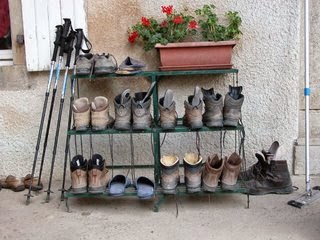
As a further juxtaposition to the items that come from Central America, is the collection of boots or various sorts, depending on the type weather or ground cover there is outside. When it's icy, as it is right now, you don't wear the dressier 'cowboy' boots. You put on the low-ground, treaded boots. My super-duper warm boots, Sorels from Canada are out of sight but with the high of minus 8 today, and it's now minus 15, you might consider those.
Just for good measure, there's Orange Guy and the tail of Young Guy as he saunters out of the picture.
16 January 2007
Not the photo I wanted to post... a missed opportunity

This evening I actually took my camera to the local supermarket because I wanted to get a photograph of the poor grackle that has been trapped inside the store since last week. It has been flying from one side of the store to the other, above the aisles, above the racks to alight on the signs that are on either end of the store, you know, the big signs that read, 'Fruit and Vegetables,' 'Dairy,' 'Meat,' or whatever (it's funny because I know that's not what they really read). Yesterday, the grapes were covered up because the bird had been going after them.
Alas, to my disappointment photographically, the workers of the market managed to get the bird outside of the store. Somehow, whether it was the manager capturing it in a net, or their just chasing it once the customers were out of the store, the bird escaped into our minus 10-degree nights.
So, you'll just have to imagine a panic-stricken grackle swooshing from one side to the other of the store or perched over the signs (leaving plenty of guano, too... sooner or later, the health officer would have shut the store down).
Instead, you get an exciting photo of the PARISH REGISTER (with a pen attached with year so that it won't walk)!
Fair enough. It's that time of year when everyone in The Episcopal Church is fussing over Average Sunday Attendance (ASA), budget deficits (or for the lucky congregations surpluses), how many members there are or aren't, how many services of Holy Eucharist one had, etc. The parochial report has greatly changed since I first started doing it 13 years ago. It is a much more stream-lined version of what it used to be.
Concurrent with tallying all those numbers is getting ready for annual meeting (this Sunday), an event that always leaves me catatonic afterwards. Thank God there is a clerk who can tell me what we did.
So heigh-ho, here we go.
15 January 2007
Pie in the Eye

Our public radio has extensive weather reports (a five-minute long thing at 12.13 every day) called, 'Eye on the Sky.' When the actual weather doesn't meet the forecast, I call it, 'Pie in the Eye.' We got royally pied today. We were supposed to get 6-12 inches of snow, our first real snowstorm this entire winter.
Instead, it snowed about 2-3 inches in the morning and the rest of the day it sleeted and rained. The temperature rose all afternoon up to 30. The day was so grismal and dark that it was hard to do much of anything.
Note how wet the road is. Tomorrow the temperatures will drop and tomorrow night we'll go sub-zero (-15) but what good is that?
This winter has been so pitiful, so pathetic, I would just assume it be over now. It's the worst, most boring, snowless winter since I moved full-time up here 12 years ago. If I wanted weather like this, I would have stayed down in NYC or NJ. Not.
Sign me, 'A frustrated snow-lover.'
We Shall Overcome

Has anybody seen my dear brother, Martin?
Can you tell me where he's gone?...
I just looked around and he's gone….
Con todos los santos y santas, ángeles y archangeles…
Martín.... ¡Presente!
Disparate memories connected to Martin Luther King, Jr... the first from a mass I attended in a Roman Catholic Church, Manangua, Nicaragua, May 1984, at the height of the contra war. At the moment of the preface to the sanctus, the congregation started to call out the names of the dead — their family members who had died that week, those who had died in the conflict and then they started to cry out other names associated with struggles for justice and equality. They called out JFK, and yes, blessed Martin. After each name, the congregation as a whole responded, ¡Presente!, present.
Fast forward to this past year in the southern part of France, the next-to-last overnight before crossing the Pyrenees into Spain. We stayed at a raucous hostel, run by the Basque man in the photo here, who is leading the pilgrims in song between meal courses (as the apératif and wine flowed).

Pilgrims wanting a quiet night were bound to be disappointed because our host spent the entire dinner time singing Basque and other popular songs. After the forty-five pilgrims had eaten a wonderful Basque meal, the host then asked around the room what nationalities were present. US, Germany, France, Switzerland, Québec. He came over to where we three US pilgrims were sitting and asked us to sing a 'national' song. We panicked and said we couldn't. So he went off and asked someone else to sing a song, which she did. He came back to us. In the short amount of time we had to think, Compa and I decided (because our friend would have no part of this; it was just too much) that the one song we felt represented us was 'We Shall Overcome.'
We started to sing it and we hadn't even made it through the first verse when the rest of the room joined in with us. We sang three more verses of it, with everyone singing with us. When we ended, they applauded loudly and for a long time. The applause really wasn't for us (it was the only applause that evening), it was for the sentiments of a song that could surpass nationalities and united people from around Europe and beyond.
+
Yet to read today MLK Jr's words from the 1960s shows us how little we really have progressed. That we should be still be talking about eracism, and needing our church to establish a 'Truth and Reconciliation Commission,' that we are only beginning to explore in the northern states our role in sending and owning the slave ships, shows how much more work needs to be done.
To keep at this work, to keep our courage, may we continue to sing the old civil rights songs, and always remember our forebears who gave their lives for God's justice.
As a newspaper clipping from 6 April 1968 reported:
"During the first week of February, the Rev. Dr. Martin Luther King, Jr. told his congregation at Ebeneezer Baptist what he wanted for a eulogy..." After King explained to his flock that he didn't want a long funeral or a long eulogy but he asked them to tell the one who would preach at his funeral, the following.
"I'd like someone to mention that day that Martin Luther King Jr. tried to give his life serving others. I'd like somebody to say that day that Martin Luther King Jr. tried to love somebody. I'd want you to say that day that I tried to be right and to walk with them. I want you to be able to say that I did try to feed the hungry. I want you to be able to say that day that I did try in my life to clothe the naked. I want you to say on that day that I did try in my life to visit those who were in prison. And I want you to say that I tried to love and serve humanity.
"Yes, if you want to, say that I was a drum major for justice. Say that I was a drum major for peace. I was a drum major for righteousness. And all other shallow things will not matter..." He concluded: ""And that is all I want to say. If I can help somebody as I pass along, if I can cheer somebody with a well song, if I can show somebody he's travelling wrong, then my living will not be in vain. If I can do my duty as a Christian ought. If I can bring salvation to a world once wrought. If I can spread the message as the master taught, then my living will not be in vain."
May you rest in peace and rise in glory, Martin.
14 January 2007
Epiphany 2C • 14 January 2007

We have a tendency to associate this gospel reading from John uniquely with weddings, partly because it talks about the wedding at Cana, and partly because it is an option for the service of Holy Matrimony. The creators of the lectionary, therefore, have placed alongside it the reading from Isaiah, which places the covenantal relationship between Jerusalem and God in terms of a marital covenant. But there is a greater depth and richness to the reading from John than marriage. The depth and richness speak to us about change and transformation, the change and transformation that come through Jesus Christ’s life, death and resurrection.
+
It is thought that this story from the second chapter of John fits into a category of writings that is known as ‘miracle stories.’ The purpose of these stories was to present a series of stupendous miracles to convince potential converts that Jesus was the Messiah. In a peculiar way, it was missionary writing. Its basic idea was that Jesus was the prophet of the new age, recalling other holy men, Moses, Elijah, and Elisha. By evoking the Jewish prophets, the writer of the gospel of John hoped to convert first-century Greek-speaking Jews to Christianity. But this particular conversion was a difficult one: the Christians had already been expelled from the synagogue. The writer’s purpose was not only to convert outside people but also to force the Jewish Christians to stop concealing their faith. He resorted to using these miracle stories, expanding them with dialogues and discourses, and then he combined them with the passion story and resurrection narrative to make the larger point of telling these stories. The larger point of these stories is to explain Christ’s coming into the world (which we heard Christmas Day and the First Sunday of Christmas in the magnificent prologue to the Gospel of John) that brings about a crisis, a decision between light and darkness, truth and falsehood, life and death.
But this miracle story at Cana is simply bizarre! If, as a true miracle story, it is meant to edify and inspire, it falls short of the mark. The narrator does not even indicate that the guests were aware of the domestic crisis, the lack of wine at the wedding feast. Jesus snaps at his mother, distancing himself from her, even though she is the one who clues him in on the shortage. His response to her is puzzling: ‘My hour has not yet come.’ Even after the water has been changed into wine—something that happens but which is not attributed directly to Jesus — the guests still do not know that a miracle has happened: the steward knows he is sampling fine wine; the servants know where it came from, but no one says out loud what has happened. For some hearers even, it is troubling that the miracle focuses on wine rather than on a healing or like transformation.
Since this so-called miracle story is so strange, it calls us to look beyond the actual sign to the deeper meaning. It is here where we find the true story of transformation and change. On the surface it is water that is changed into wine. Deeper than that transformation is our relationship with God that is about to be transformed.
We are not to take the Cana miracle as a direct and complete epiphany of Christ’s glory. Though the evangelist accepts the reality of the miracle, it has a further symbolic significance, pointing toward what Jesus is to accomplish on the cross. Hence, his saying to his mother, ‘My hour has not yet come.’ It is not yet time for him to change the nature of our salvation. On the cross, the old order shall be replaced by the new. This is what the changing of the water symbolises. The real, final epiphany is the cross. It is hard for us to think already to the cross when we have just celebrated the nativity, but the cross is where our journey leads us. The gospel of John, the gospel of seven signs, of which this is the first, points us to the cross and then the resurrection.
At the same time that the sign — the changing of the water into wine — points us to the cross, it also reminds us of God’s sur-abundant generosity and grace. The wine reminds us of the messianic banquet which overflows with reconciling joy, where — in the words of Isaiah paraphrased — we shall no more be called ‘Forsaken’, our land shall no more be called ‘desolate’… because the Lord delights in us. Just as Israel hoped in its future and joyful relationship with God and one another, so do we.
Jesus is the agent of change. He is the agent of change in renewal of the church, us the baptised. Jesus, the crossroads between humanity and God, is the one through whom our relationship with God and one another is changed from despair to hope, from death to life. Jesus, God incarnate, is the one who reminds us of God’s generosity and grace.
+
But, like Mary in this story, we have to trust… even when we cannot control or fully understand what is happening. And we have to let go of what we have in order to become something new.
This process of transformation happens on a personal and corporate level. Think of how you personally have changed over the past year. Think of how we, as a parish, have changed. Whether the change and transformation have been in our selves, our families, our circle of friends, or our parish, some of it has been intentional. Some of it has simply happened, outside of our control. Some of it we have liked. Some of it we have not. Think of what transformations there have been — positive ones. Think of where we have been able to let go of old thinking and ways in order to do something new and creative. Think of where we have been able to trust… for a large part of the process of transformation comes from that initial step of trusting in God. Trusting that all will be well. And that is hard to do.
There seems to be a knee-jerk reaction to the words, ‘change,’ and ‘transformation.’ I know‚ I have that reaction sometimes (I am rather feline in that respect). The word, ‘change’ seems to provoke a greater and, perhaps, more negative reaction than ‘transformation,’ which seems more gentle and less threatening. Yet, as I speak these words, I know that we, as a parish, will undergo changes and transformation over the next year. It happens every year; this process is something to expect, it is inevitable. People move away, others join us; some are born and some will die. The changes can be painful — no one likes loss. But change can also bring forth new life. That transformation is perhaps the harder thing to trust because it is less certain.
Transformation and change can be wrenching if there is no foundation. If the transformation of water into wine is happening for no reason, then it is meaningless. If there is no way to make sense out of the change and transformation, then it is pointless. But when we place the changes and transformations into the context of the salvation story, we are better equipped to deal with them, because the salvation story gives us firm ground on which to stand, even when things are shifting around us. The salvation story — God’s grace and mercy coming to us in Christ—is our firm foundation. With that firm foundation, we are better equipped to withstand the chances and changes of our lives, and to give thanks.
Remember all this the next time you have a glass of fresh, clear water or fine wine and give thanks….
[credence at the side altar before the 8.00 HE]

We have a tendency to associate this gospel reading from John uniquely with weddings, partly because it talks about the wedding at Cana, and partly because it is an option for the service of Holy Matrimony. The creators of the lectionary, therefore, have placed alongside it the reading from Isaiah, which places the covenantal relationship between Jerusalem and God in terms of a marital covenant. But there is a greater depth and richness to the reading from John than marriage. The depth and richness speak to us about change and transformation, the change and transformation that come through Jesus Christ’s life, death and resurrection.
+
It is thought that this story from the second chapter of John fits into a category of writings that is known as ‘miracle stories.’ The purpose of these stories was to present a series of stupendous miracles to convince potential converts that Jesus was the Messiah. In a peculiar way, it was missionary writing. Its basic idea was that Jesus was the prophet of the new age, recalling other holy men, Moses, Elijah, and Elisha. By evoking the Jewish prophets, the writer of the gospel of John hoped to convert first-century Greek-speaking Jews to Christianity. But this particular conversion was a difficult one: the Christians had already been expelled from the synagogue. The writer’s purpose was not only to convert outside people but also to force the Jewish Christians to stop concealing their faith. He resorted to using these miracle stories, expanding them with dialogues and discourses, and then he combined them with the passion story and resurrection narrative to make the larger point of telling these stories. The larger point of these stories is to explain Christ’s coming into the world (which we heard Christmas Day and the First Sunday of Christmas in the magnificent prologue to the Gospel of John) that brings about a crisis, a decision between light and darkness, truth and falsehood, life and death.
But this miracle story at Cana is simply bizarre! If, as a true miracle story, it is meant to edify and inspire, it falls short of the mark. The narrator does not even indicate that the guests were aware of the domestic crisis, the lack of wine at the wedding feast. Jesus snaps at his mother, distancing himself from her, even though she is the one who clues him in on the shortage. His response to her is puzzling: ‘My hour has not yet come.’ Even after the water has been changed into wine—something that happens but which is not attributed directly to Jesus — the guests still do not know that a miracle has happened: the steward knows he is sampling fine wine; the servants know where it came from, but no one says out loud what has happened. For some hearers even, it is troubling that the miracle focuses on wine rather than on a healing or like transformation.
Since this so-called miracle story is so strange, it calls us to look beyond the actual sign to the deeper meaning. It is here where we find the true story of transformation and change. On the surface it is water that is changed into wine. Deeper than that transformation is our relationship with God that is about to be transformed.
We are not to take the Cana miracle as a direct and complete epiphany of Christ’s glory. Though the evangelist accepts the reality of the miracle, it has a further symbolic significance, pointing toward what Jesus is to accomplish on the cross. Hence, his saying to his mother, ‘My hour has not yet come.’ It is not yet time for him to change the nature of our salvation. On the cross, the old order shall be replaced by the new. This is what the changing of the water symbolises. The real, final epiphany is the cross. It is hard for us to think already to the cross when we have just celebrated the nativity, but the cross is where our journey leads us. The gospel of John, the gospel of seven signs, of which this is the first, points us to the cross and then the resurrection.
At the same time that the sign — the changing of the water into wine — points us to the cross, it also reminds us of God’s sur-abundant generosity and grace. The wine reminds us of the messianic banquet which overflows with reconciling joy, where — in the words of Isaiah paraphrased — we shall no more be called ‘Forsaken’, our land shall no more be called ‘desolate’… because the Lord delights in us. Just as Israel hoped in its future and joyful relationship with God and one another, so do we.
Jesus is the agent of change. He is the agent of change in renewal of the church, us the baptised. Jesus, the crossroads between humanity and God, is the one through whom our relationship with God and one another is changed from despair to hope, from death to life. Jesus, God incarnate, is the one who reminds us of God’s generosity and grace.
+
But, like Mary in this story, we have to trust… even when we cannot control or fully understand what is happening. And we have to let go of what we have in order to become something new.
This process of transformation happens on a personal and corporate level. Think of how you personally have changed over the past year. Think of how we, as a parish, have changed. Whether the change and transformation have been in our selves, our families, our circle of friends, or our parish, some of it has been intentional. Some of it has simply happened, outside of our control. Some of it we have liked. Some of it we have not. Think of what transformations there have been — positive ones. Think of where we have been able to let go of old thinking and ways in order to do something new and creative. Think of where we have been able to trust… for a large part of the process of transformation comes from that initial step of trusting in God. Trusting that all will be well. And that is hard to do.
There seems to be a knee-jerk reaction to the words, ‘change,’ and ‘transformation.’ I know‚ I have that reaction sometimes (I am rather feline in that respect). The word, ‘change’ seems to provoke a greater and, perhaps, more negative reaction than ‘transformation,’ which seems more gentle and less threatening. Yet, as I speak these words, I know that we, as a parish, will undergo changes and transformation over the next year. It happens every year; this process is something to expect, it is inevitable. People move away, others join us; some are born and some will die. The changes can be painful — no one likes loss. But change can also bring forth new life. That transformation is perhaps the harder thing to trust because it is less certain.
Transformation and change can be wrenching if there is no foundation. If the transformation of water into wine is happening for no reason, then it is meaningless. If there is no way to make sense out of the change and transformation, then it is pointless. But when we place the changes and transformations into the context of the salvation story, we are better equipped to deal with them, because the salvation story gives us firm ground on which to stand, even when things are shifting around us. The salvation story — God’s grace and mercy coming to us in Christ—is our firm foundation. With that firm foundation, we are better equipped to withstand the chances and changes of our lives, and to give thanks.
Remember all this the next time you have a glass of fresh, clear water or fine wine and give thanks….
[credence at the side altar before the 8.00 HE]
Subscribe to:
Posts (Atom)