30 September 2006


Highway Madness

I did a quick trip down to my parents' yesterday/today, some 500 miles round trip on I-89, I-91 and the Merritt Parkway. The highways and byways were an absolute zoo. I am amazed to be back home in one piece.

The Merritt Parkway, opened in 1938 as a nice parkway to enjoy at no more than 45 mph (I can remember my grandparents' and even my father's recollections about it), is a race track. I pot along at 70 mph in a 55 mph speed limit, while cars plow by me at at least 80 mph. No wonder there was a huge tie-up in Trumbull, CT, so bad that I bailed out, drove through Long Hill and came back to the Merritt by way of Rte 25, circumventing it. The accident must have been bad since the entire road was plugged up: nary a car coming through. It was also getting backed up on the southbound side. I suspect someone barrelled into the bridge where the road curves.

And I-91 yesterday in Springfield MA was just as bad -- closed down for a couple of hours because of truck accidents on both sides.

No wonder I like being back up north.

I-91 represents a major thread of my life and my past. My family used to go up and down that road en route from CT to VT. I remember in 1969 when my parents woke us children up so that we could enjoy going on the finished segment of I-91 from West Springfield to Northampton, MA, thereby avoiding the Rte 5/Rte 9 jam up in NoHo. Then there was the time that we stopped in CT somewhere at night to look at northern lights, one of the two times in my life that I have seen them. I have gone up and down that road for 40 years, almost all my life and shall continue but with less pleasure. Pure and simple, neither the Merritt nor I-91 can handle the volume of traffic these days. I breathe again once I hit Greenfield MA and can put the cruise control back on. Ouf.

28 September 2006

Cool Nights

Fall is arriving with its cool nights and I broke down this morning and put the chamarra back on the bed. It's a beautiful Guatemalan blanket I bought in Chichicastenango in 1987, when Guatemala was somewhat tranquil. Its wonderful quetzal sitting on a tree branch has provided, over the years, a fun background for taking photographs of the cats. They sometimes look as though they are sitting right on the branch.

Getting that blanket and a two other blankets back from Guatemala was an interesting feat because they couldn't possibly fit into my suitcase, so I bought a canasta (big basket), and my Guatemalan hosts found me a rope net that we tied around the canasta. I checked the ensemble (flying on Eastern, remember them?) and remember being horrified when we landed in Miami (an airport I assiduously try to avoid) because it was pouring rain and they weren't protected by any plastic baggies. Somehow I managed to lug all of that through customs and onto the train back home.

I have little throw pillows that are Guatemalan, cat-shaped pillows that are Panamanian molas as is a hibiscus one, and hand-embroidered 'Sweet Dreams' pillows come from a woman prisoner in El Salvador. I don't know if she is well or not; she is HIV-positive and has been in and out of the hospital recently. These last pillows serve as a prayer reminder for her and the other women in the Salvadoran jail whom I have met in the past two years.

Just because I live in the frozen north doesn't mean that I can't have colourful things to keep myself warm.


Loon Protection

The sign that greets boaters at the sign-in for Green River Reserve makes it clear that the state is serious about protecting loons. The map shows a huge area that is off-limits during loon nesting season.

A couple years ago on Lake Umbagog in NH/ME, I got to see two parent loons teaching their little one how to fish and dive. And the little loon really did ride around on its parent's back.

It's hard to remember the loon's haunting call when back here I hear the Vermonter train whistle echo through the valley but I know that they are out there tonight calling to one another.

27 September 2006


Green River Reservoir

Up in north central Vermont, above Stowe, lies Green River Reservoir. The lake, formerly the property of the Morrisville Electrical Company, bought in 1999 by the Nature Conservancy, remains the premier paddling preference of Vermonters. With all of its inlets and coves, the lake has 19 miles that a canoer and kayaker can cover. Best yet, no motor boats are allowed on it. Since it is now a park, there will be only one house visible from the water. It is quiet, beautiful and restful.

Compañera and I went off for the night camping Monday-Tuesday. It was a last-minute decision, made by looking at our already too-full calendars and the realisation that fall is here and soon it will be too cold to do such a thing. It was somewhat a comedy of errors getting off -- we left the cooler with our dinner in the kitchen so had to stop at a market en route to buy something to eat -- but we did finally get going and out by mid afternoon.

We probably paddled 15 miles, down and around, checking out 'real estate,' that is, future camp sites. The one we got, no. 6, is perfect for evening light but it is a bit breezy. Nowhere does there seem to be easy access to landing; every site had some sort of obstacle that would do in a kevlar canoe.

The lake is a loon nesting reserve and, indeed, the loons were out and about. Monday night their antiphonal calls (clear call and then tremelo) echoed up and down the lake. I love their cries for their haunting sound. Both days paddling, we saw loons, fairly up close even.

The ranger who is at the lake for the summer said that he had seen a mountain lion but I don't know if that was just to see what our reaction would be. I think I startled an otter when I went down to the lake to dip my hands in it. We didn't see any moose either, but they are there.

It was way too windy to paddle anywhere Tuesday morning. The wind kept shifting, which made getting out of our site difficult and Compa fell in trying to put our things in the canoe. (I had on my Chacos and went into the warm water up to my knees.) So, all we did was paddle back to the put-in. Fine by me since I have a low-grade fall cold.

The mountains (Mount Mansfield and Worchester ranges) were gorgeous yesterday afternoon -- deep, deep blue against a fairly blue sky. The trees are finally beginning to change. Vermont is doing its usual fall thing and it's lovely.

24 September 2006


Proper 20B

The lectionary this morning provides us with an interesting contrast of lessons — the first two speak about wisdom and the gospel narrates the second of three predictions about the passion, followed by instruction about discipleship. When the texts are placed together, one can find a thread that links wisdom with discipleship.

The Letter of James draws heavily from the writings of Ben Sirach (in the apocrypha) and Wisdom, both of which witness to the practical morality expected of Jews in their personal, family and business lives. James is a concrete writer, however: the metaphors used in James are taken from the world around us rather than from revelation — think of the image of the person looking into a mirror we heard a few weeks ago who, does or does not remember what the reflection is.

The segment in front of us invites us to look at the following sequence of opposites:

Wisdom that is earthly brings forth bad fruits of conflicts, discrimination, disorder, and wickedness. In one’s inner life, this earthly wisdom causes selfishness, envy and greed.

Wisdom that comes from above brings forth good fruits of gentleness, mercy, impartiality, and peace. One’s inner life is pure and close to God. This purity and closeness produce peacefulness in the world and in one’s heart. This shalom imbues one’s life and integrity.

Clearly, the writer of the letter expects that we will opt for the second set of values. But I think the writer also realises that in our creatureliness, we often fall for the former set of values. And so our life journey consists of letting go of earthly wisdom for that which comes from above.

+

The gospel of Mark shows us by example a group of people who have not yet obtained that wisdom from above. We have entered into the second teaching cycle of Mark’s gospel, the longest of the three. In it, Jesus will talk about the greatest and the least, the outsiders and insiders, the aggressors and victims, men and women, children and adults, and the rich and the poor. In short, he will cover all segments of his population — opposites which parts of the letter of James also addresses. The teaching, ‘The first will be last,’ frames this entire section.

At the same time that Jesus teaches about the strong and weak of his society, he also predicts his passion — here, for the second time. For the second time, the disciples respond with a very earthly, concrete wisdom (if we can dare call it that) — one that really is blind and deaf to what Jesus has just said. For the second time, they don’t get it. This time, they are arguing about who will be the greatest amongst them. They miss understanding that the cross calls them to a life of servanthood. They don’t understand that they are not being called to be part of a powerbase but to be part of a community that redistributes power to the excluded and marginalised. They do not understand that taking up the cross means they will be the last and servant of all. Lastly, they do not understand Jesus’ wisdom which is based in conscience.

Jesus’ teachings speak to a wisdom that runs counter to that of the world: the greatest are the least. Outsiders are welcome. Women and children in his society have value and integrity. The rich are poor and the poor are rich. In Jesus’ words, wisdom consists of reversals.

Of course, the disciples cannot understand these words — they miss so much in the gospel according to Mark. It is those on the margins, such as demons and unclean spirits who can see Jesus for who he really is and the disciples don’t. They are so outcast that they have no pretensions — they can see and call things are they are because they have nothing to lose; they have already lost everything.

We, though, have the gift of time and tradition to understand better what the biblical sense of wisdom meant and how we should embrace it. It’s only a question of our pretensions and ‘sophistication’ of getting in the way. Sometimes we need to let go of all that to see truly.

+

The reclusive and prolific early 20th-century French author, Marcel Proust wrote, ‘We do not receive wisdom, we must discover it for ourselves, after a journey through the wilderness which no-one else can make for us, which no-one can spare us. For our wisdom is the point of view from which we come at last to regard the world.’

Discipleship to Christ invites us, demands us to make that journey through the wilderness. Whether as an individual or as a community, Christians have long known the value of spiritual, internal pilgrimage. Christians have also respected the work of a community.

+

It is hard gaining wisdom, so perhaps it helps to start small.

One of my favourite French authors, André Gide, another early 20th-century writer, said, ‘The wise are those who marvel at everything.’ A major piece of our life of faith is to see the miraculous in the common, the wonders of the ordinary. Perhaps that is why Jesus points our attention to a child. André Breton said that ‘childhood is the nearest thing to life.’ Robert Ellwood added, ‘A childlike sense of wonder is the key to understanding the mysteries of the esoteric universe.’

My brother and I had more fun playing outside in the small brook that bisected our backyard from the lawn and the woods. In the rather swampy woods, we would spend hours, running on top what we called ‘heffalumps’ (those mushy grass mounds at tree trunks), trying not to fall in the water. We’d play hide-and-seek in the grape arbor near the brook. The outdoors contained endless possibilities for discovery and delight. Those hours spent outside cultivated a life-long enjoyment of God’s creation, which has led me as an adult to learn how better to care for it as we increasingly burden it with our excesses.
I think that no matter how difficult and awful a child’s external life might be, a child still has incredibly resiliency. I remember pictures of children playing among the ruins of Sarajevo, or even today in Lebanon or Palestine. Children have the amazing capacity to find things in which to delight despite it all.

What things delighted you as a child? Where did you tap into the wonder that so characterises a child’s awe at something new? What made you giggle? Where, as a child, did you find God in the world around you?

I think one of Archbishop Desmond Tutu’s greatest strengths is, despite his having seen the worst that humanity can do to itself, he still can giggle like an imp. He hasn’t lost the childlike wonder in God’s creation and world. Maybe it is because he was so sickly as an infant (with polio among other things) that his grandfather gave him the name, ‘Mpilo,’ or ‘life.’ Tutu has lived out that hopeful name and has translated his wonder of God’s creation into an amazing life-journey of being a ‘rabble-rouser for peace.’

By finding the ability to marvel at what the world might consider small might help us gain wisdom. For gaining wisdom is actually coming closer to God. If we remember that Wisdom in early Christian thought was the Holy Spirit, then by seeking God in the daily and small things of life will enable us to find God in the harder parts of life.

Ultimately we quest for Shalom, an integrated life of integrity. Wisdom becomes one of the paths on which we walk in that search for wholeness and completeness. As we receive Wisdom, then we are also better able to take on the hard work of being one of Jesus’ disciples, which involves participating in the great reversals that Jesus so often preached, wherein the poor become rich, the weak strong and where we are able to take up our cross and follow Jesus.

23 September 2006


The Great Pew Removal:

It's one of those slate blue/grey days outside, which heightens the fall foliage. The sun comes and goes, but it's too wet outside to do any hiking.


So, instead, this morning I kibbitzed and supervised the removal of the front pew on the left side of the church. Last year, the pew on the right side of the church was taken out, which made it possible to have some space to pull the side altar out further from the wall. Now, with the left side taken out, it means that we can set up a "soft space" for the children to sit up front.

The pews are about 150 years old, probably made out of pine, once upon a time painted white and then later on, shellacked with wood varnish that is water-based so that when it is hot and humid, the pews stick to people's clothing. They are quasi-box pews, without the doors, but with a center divider that runs the entire length of the eight rows. Removal was less difficult than anticipated; with just two small pry bars and some pushing, the pew came unstuck from the front railing. It didn't take too much to get it unhitched from the center divider. And, it was easily carried in two pieces across the front lawn to the shed, where it will await pickup from the lucky person who bid for it.

Oddly, there hasn't been any flap about removing the pews. Perhaps it is because attendance is about a fifth of what the church can hold; we just don't need all that seating. Perhaps it is because people don't really notice such a thing. Whatever. I did find it interesting when a vestry member suggested that we remove ALL the pews. Ahh... my dream is to set up a cooperative with one of the furniture makers in Nahuizalco, El Salvador. There they make beautiful hand-cut wooden furniture with cane backs and seats. Can you imagine having nice cane chairs, made by a cooperative that would help out folks in El Salvador, while providing folks up here some true beauty rather than boring chairs that come from one of the multitudinous school/library/hotel furniture makers, whose catalogues seem to proliferate in my mailbox?

It is far easier to deal with the supposed trauma of removing a pew from the church than to contemplate the absolute craziness that seems to be fomenting itself in the world-wide Anglican Communion with statements such as the one that came out of Kigali. Even the meeting of the 21 TEC bishops in Texas is too much for my heart to bear. So I fuss with silly things, like pews.

22 September 2006

Getting Organised

Just as any elected body spends time getting set up (as I think about how long it took this year's General Convention meeting in Columbus to 'get organised'), it's taking a bit of time to get this blog up and running.

Until I figure out how to get links added, I suggest going over to http://frjakestopstheworld.blogspot.com. His blog has more than enough links, many of which I will add here.

Yesterday's Hike

Since I knew the weather was going to be crummy this weekend, I took the afternoon off and headed up Hunger Mountain, outside of Montpelier, VT. It was a glorious fall day, not too hot and dry. The leaves are beginning to change so the hillsides are a mix of green, yellow, brown, orange and the occasional bright red. Usually I go up the Waterbury side, which is 2.2 miles of fairly steep hiking, ending with a bit of climbing up rocks. This time I took the Middlesex route which is 2.8 miles long, but the first 1.6 miles are easy, going up an old carriage path, which used to take people to a hotel up top. The last 0.3 mile is fun, however, as it entails a fair amount of slabbing.... including going up a short portion holding onto a rope because it is steep (though it can be done sans aid). The view was fairly clear, 70 miles down to Killington/Pico, over to the Adirondacks, and mountains in NH. The Presidentials, however, were obscured by the haze. I love going up Hunger Mountain because from there, I can see Camels Hump, that funky mountain profile which is on the Vermont quarter and on our environmental license plates.

Though I was walking alone, it was far from a solitary hike because there were 28 7th and 8th graders from an area school, coming down en masse. They had been out on a science trip but their social studies teacher was along with them, so I told the kids that Vermont only used to be 30% forested a century ago. Now it is the reverse. Nice way not to have to stay in school!

This time of year is perfect for hiking. The bugs have died off, the crowds have died down, it's not unbearably hot and usually it is dry so the views are good, too. Always, hiking is a restorative action for the body and soul.


Friday Cat Blogging

Here's the crowd.

See how they love one another... the middle cat, orange tabby (eight year-old male), and the oldest (ten year-old female). There's usually one good brawl a day and it is not always between the same two. Sometimes all three get going!

This photo comes from a hot, hot day this summer. He's the youngest (five years old).

I have had cats all my life. I wasn't intending on having three; on my own, I have only had two cats, but the third one (the young guy) found his way into our lives, for which I am glad.

21 September 2006


Lecturas

What a quandry... do I start reading Frank Rich's latest, The Greatest Story Ever SOLD, or Kerry Egan's Fumbling: A Journey of Love, Adventure, and Renewal on the Camino de Santiago? Do I go with the current political mess, or retreat into another person's journey on the Camino de Santiago, something that is so dear to my heart since I have walked almost half of the Camino in Spain (beginning and end) and the entire Via Podensis (Le Puy to Saint Jean-Pied-de-Port and then over the Pyrenees into Roncesvaux/Roncesvalles, Spain)? Such a dilemma. I won't even peek into the book I am giving my father for his birthday, Cherie Burn's The Great Hurricane 1938... he was 14 at the time and I want to know how the book squares with his memories.

It's 35 out, so it's time to get into bed. The cats will be sure to join me.


It seems fitting to start a blog on the automnal equinox, the day when, up here in the northeast, close to Canada, we have twelve hours of daylight and night. Soon, it will be more night than day. And soon, the brillant reds and oranges of the fall leaves will be on the ground, and we will be facing eight months with bare trees.

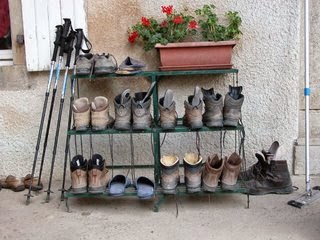
In the past two years, I have discovered the wonder of long-haul walking and hiking up mountains. The photo of boots, stacked up at the end of a 28 km day (in France this spring) are for me a lovely reminder of what it means to 'hit the road.'

So, I see this blog as a place to post photos of mountain hikes in my beautiful state and muse about various things, political, ecclesiastical and whatever else strikes me.

Lastly, there will definitely be 'Friday cat-blogging,' as three felines share my life.