

Ever since I was little, I have loved looking at and saving photographs. Before the willow tree roots in our backyard plugged up the drain pipe from our basement and subsequently caused a three-foot deep flood down there, I had a wonderful collection of Life magazines from which I would make collages. There’s something about the elegance, simplicity and power of a superbly executed photograph. If I were to cite ones that have stuck in my mind over the years, I suspect many of you would remember them, too. So I am always on the lookout for a photograph that conveys a truth that words sometimes cannot.
When the photograph I am going to pass around came out in March 2002, I clipped it, knowing I would use it someday. Chang Lee, of the New York Times, took this shot of an Afghan family of refugees on their way home after living for 22 years in a refugee camp in Pakistan. (1) It’s hard to make out but there’s a faint rainbow in the background. What hit me when I first saw the photograph are the bright colours and designs painted on the sides of the truck, even on the gas tanks underneath the truck. The truck itself looks fairly ancient and the artistry disguises what probably is a brutal truth: this truck and the few pieces of furniture sticking out the back of the truck are the family’s sole possessions.
In my limited travels throughout the world, I have long noticed the use of colour, bright designs and artwork. It seems that the poorer the community, the brighter the colours, the more imaginative the designs, as though they cover up the world’s harsh realities. Certainly this has been my observation in Thailand, Guatemala, Panamá, Nicaragua and El Salvador.
When I hear this morning’s story of the flight of the Holy Family into Egypt, I see them in that brightly painted truck, rumbling their way through the desert, with perhaps a faint rainbow in the sky to guide them as the star did just a short while before.
Their story of flight is humanity’s story. Whether it is the men from Sudan who spent their childhood roaming from one country to another seeking asylum and a safe haven until they landed in Vermont, or a young man from Zaïre escaping persecution who now works at Norwich University, or the Guatemalan Ixcot family that has been living in sanctuary at Weston Priory since 1985, or a battered woman who flees her house to return to her parents’ home, even our lives in Vermont are touched by refugees. Perhaps in a moment in your life, you have been a refugee, too, running away legitimately from a dangerous situation.
+
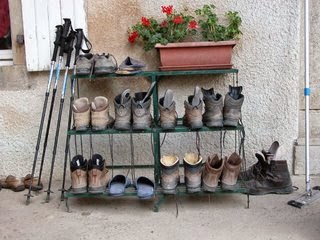
At the same time that being a refugee is so much a part of humanity’s story, so is being a pilgrim. The difference between being a refugee and a pilgrim is an important one even though both involve travel, movement and displacement. While there are times that we have to be refugees, we are called by our faith more to be pilgrims all the time, moving on a spiritual journey that nourishes us and feeds us. Indeed, early church writers saw the flight of Joseph and Mary more as a pilgrimage, a new Exodus, rather than a story of refugees. Even the gospel writer of Matthew saw the story as one establishing the parallels between Jesus’ early life and that of the Israelites going down in Egypt and returning as well as Moses’ life story. In those cases, Jesus, the Israelites and Moses were first-most pilgrims.
Another big difference is that usually being a refugee means running away from a threat, an instinctive survival action, whereas being a pilgrim is a matter of choice. One makes a conscious decision to become a pilgrim, as what a visitor to the Iona community in Scotland wrote of pilgrimage, ‘Pilgrimage is feet-on-the-ground spirituality.’
Ruth Burgess, another Iona writer, states, ‘Pilgrimage is traditionally a journey to a holy place — a place where saints have walked, a place where God has met people and blessed them. People through the ages have journeyed with God on pilgrimage… pilgrimage is an opportunity to travel lightly, to walk free of daily routines, to meet people, to make friends, to enjoy and celebrate God’s creation. An opportunity too in the travelling, the conversations and the silences to reflect on the journey of our lives and on our journey homewards to God.’ (2)
Some might say that our move today to Nourse Hall at the end of the late service represents an exile, exile from this beautiful prayerful space of an old and lovely Gothic church. [The furnace is doing a great job today of giving us a preview of how this church will be next week!] We will process after communion and before the final blessing, carrying our prayer books and hymnals, symbols of our Epiphany and Lenten pilgrimage. Instead of looking upon our winter months in Nourse Hall as an exile, let us consider them as part of our pilgrimage as a congregation. The journey may well lead us to discover news forms of mission and outreach with the money saved and a better appreciation of being stewards of God’s creation by not burning up so much oil.
Pilgrimage does not involve only physical displacement. Pilgrimage can also be an internal journey. For those of us who cannot afford the time or luxury of going on a pilgrimage that involves physical motion, we can at least embark on a spiritual pilgrimage that will lead us closer to God.
Peter Millar of Iona writes: ‘Christians can be described as the “pilgrim people of God,” and in the Bible this idea of the spiritual life as a “journey” is expressed many times…. The outward pilgrimage is a sign of this inner journey — of repentance, resurrection and rebirth — the journey of the heart, held in the Creator’s hands. It is rooted in the conviction that life itself is a process of continual change and movement. We are never static, and we carry within us a sense of expectancy, of looking forward in hope. … The question remains: are we open to being a pilgrim? Are we prepared to live with some of the risks and uncertainties and loose ends which pilgrimage always entails? The pilgrim can never have everything neatly ‘sewn up’—there is always the exploration, the search, the movement, the questions, and the challenge.’ (3)
Being a pilgrim is not for the spiritual elite. All of us are pilgrims from the moment we are born. If we ask questions of life — why is there suffering, why is there war, why is there death, why are some people poor while others are rich, am I truly God’s beloved child, how do I help my neighbour, how do I love better my spouse or partner, how do I better understand myself, how do I better follow God — we are doing the work of a pilgrim. We can choose to run away from these hard questions, certainly life is a lot easier sometimes when we don’t face hard truths, but it is less authentic.
As people who do most of our feet-on-the-ground spirituality in our daily work, and in the midst of our family and friends, we need opportunities to be fed, to rest our souls and reconnect not only with God but also with our community of pilgrims. That is why you and I have gathered here this morning. We come to God’s table for solace, strength, pardon, and renewal. Let the grace of this communion make us one body, one spirit in Christ so that we can go back into the world serving God and actively engaging in life’s questions… rather than fleeing from them, and being God’s pilgrims in our daily lives.
END NOTES
(1) The photograph reappeared in the New York Times, Monday, 30 December 2002, The Year in Pictures, E4. I couldn't locate it on the web so what appears is a scan of a scan.
(2) Neil Painter, ed., This Is the Day: Readings and Meditations from the Iona Community (Glasgow, Scotland: Wild Goose Publications, 2002), Month 1, Day 16.
(3) Ibid., Month 2, Day 16.






2 comments:
Thank you...lovely the voyage even if it gets overly brightly colored sometimes.
This is so beautiful- it made me get teared up and really touched my heart.
And how curious - my verification words is "wises!"
Post a Comment