

The Feast of the Transfiguration, 6 August, one of the major church feasts of the year, always seems out of place to me because it comes a week before the Feast of the Blessed Virgin Mary, when we remember Jesus’ mother and our matronal saint, because we observe the Transfiguration on the Last Sunday of Epiphany and lastly because it comes in the middle of the summer, in the thirteenth week of ‘common time.’
I can’t help but come to the Feast of the Transfiguration aware of the other levels of significance attributed to this day. Just as the day seems jumbled to me by its timing in the church year, the many layers of significance to this date in history make my mind jump all over. Not only is it a major feast in the Anglican Church, it is the Feast Day of El Salvador. On or near to the Feast of the Transfiguration, the country and its expatriates celebrate the Saviour of the World, Salvador del Mundo, with masses and processions. We can remember the people of El Salvador as they recognise the One whose name they call their own, ‘Saviour.’ They have had many prophets lead them to new life-giving ways of life and they are trying now to be a people of hope despite so many difficulties. And the 6th is also the anniversary of the bombing of Hiroshima. A simple day becomes complex.
+
The gospel reading begins by saying that eight days have happened after Peter’s confession to who Jesus is, the Messiah of God. Peter, James, and John accompany Jesus up the mountain, away from the plain where he has finished preaching. The end of Jesus’ Galilean ministry has come; Jesus now resolutely turns his face to Jerusalem and the passion. At this turning point of the gospel, one at which Jesus has been identified and where the focus now shifts to the march to the cross, the action picks up.
While up on the mountain to pray, Jesus is joined by two well known historical figures, Moses and Elijah. They speak to Jesus about his exodus, which he is about to fulfill in Jerusalem. Jesus’ witnesses, Peter, James, and John, sleep through the encounter, perhaps explaining Peter’s illogical response when he finally comes to.
As the disciples are figuring out what is going on around them, a cloud overshadows them. Once again, Jesus is identified for who he is but this time, the identification comes from a heavenly voice which declares, ‘This is my Son, my chosen One.’ The voice adds a directive, ‘Listen to him,’ a command that in other gospels and this one happens at the moment of Jesus’ baptism.
If we listen to Jesus and live into the baptismal covenant, we also must keep in mind the two figures that appear to Jesus on the mountain, Moses and Elijah. Moses seemingly represents the prophetic office that Jesus will occupy — the voice calling us to be people of the Beatitudes, while Elijah pictures the hope of the world to come — the promise that we can hold out to those around us. Jesus will function as a Moses-like figure who will draw people around himself in much the way that Moses drew together the nation of Israel. With Jesus comes a new period, a new age, a new way of living and being God’s people, a new way of relating to God. And so Elijah is present on the mountain as a reminder of another time when people related to God in new, life-giving ways.
+
Normally, I like to wax eloquently (!) about the wonders of being up top a mountain. You’ve heard sermons about the awe one has of looking out across the countryside instead of being in a valley, being able to see for one hundred miles and, in the case of Mount Washington, feeling a bit of the altitude and closer to God.
Today I want to approach the mountaintop experience from a different vantage point… getting there when it’s not so great.
This past Tuesday while over in the New Hampshire Whites, we decided to take a quick 5.8 mile hike up a barely 4000 footer so we could tick it off on the list of the 48 4000 footers in NH (we’re up to 18 now, including all the 5000+ footers). Since it had been raining in the morning, and still looked foggy and overcast, we decided to summit a mountain where there is no view because the top isn’t cleared. Why waste a good day on a viewless summit when we could do it on a crummy day? So off we went.
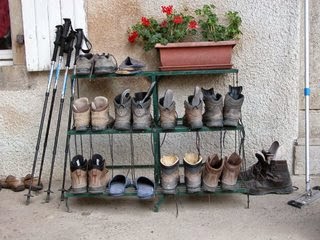
It was a miserable hike. Humidity was 100% without it raining. I was very tired and thought of quitting at least twice. I had no energy, couldn’t breathe and was annoyed by my sluggishness. Streams that normally would be easy to cross were rushing torrents. When we got within half a mile from the summit, it began to rain. Still, we slogged on through the mud, no longer worrying about keeping it off our boots and pant legs. When we got to the top, in the rain, we looked around, saw nothing because it had socked in, nodded and said, ‘OK, we’ve done it. Let’s go down.’ We turned around and left after two minutes up there. Big deal.

+
Mountaintop experiences can be like this most recent one… struggling to get there and once you’re there seeing nothing and figuring you might as well go down where at least you can get dry again. Sometimes I think this experience is more akin to what the disciples felt when they were up in the cloud with Jesus. They didn’t know what was going on.
Furthermore, getting up the mountain can be hard work. After watching Bruce Feiler’s A Walk Through the Bible, I realise just how high Mount Sinai is (7455 feet but it sticks up out of the desert). It wasn’t a walk in the park for Moses to keep going up and down the mountain. He didn’t have goretex and fleece the way Feiler did. Moses struggled in more ways than one.
+
So why do we do it? Why do we slog along if we are going to have to work extra hard without the knowledge of any pay off?
Because it is part of being faithful. The climb up one mountain is but a piece of a life-long faith journey. Continuing on even when things don’t seem to click or God seems lost in the fog is part of our believing despite not being able to see. It is part of trusting in God even when we are not sure of what is going to happen.
No matter where we are spiritually when we go up that mountain, God is up there, even in the fog, ready to remind us that we are God’s chosen. Just as God tells the disciples to listen to Jesus, so God tells us to listen to one another because we are all chosen — in other gospels, beloved.
One of the ways we keep at it is by remembering the vows we made at baptism and reaffirm. One of those is to come together to break bread and share in the prayers.
One of the transforming moments of life for me, and for many, is the moment in which the People of God — friend and stranger, wise and foolish, strong and weak, guilty and forgiven — gather around the Table of Christ and are invited to that time and place where heaven and earth are joined, where the basic things of life, bread and wine, become for us the life giving presence of the Holy One, who is not far off, but is as near as our breathing.
If that is not a transcendent, mountain top experience, what is? So, come with the prayer that we might be touched by God who is near, to be drawn to that place and time which is Holy and life giving and changing.







2 comments:
Brilliant then, brilliant still and yes... so much more that you were able to say extemporaneously!
Beautiful... I'm so glad Fran linked to it.
Pax, C.
Post a Comment